Daniels Appeal: Organizations having been granted Intervener Status


Or:

image

In addition to the Persons or Organizations named above, here is a list of the organizations who were granted Intervener Status, with their websites – bookmarked to their mission and / or values statement:

* jointly-held Intervener Status.

Appelant, Respondent and Intervenor Factum are available to consult here

It will be interesting to read the position of each organization, and try to understand the implications. If you have information that can be shared, please do not hesitate to do so (in a respectful manner, needless to say!)

If I can’t call myself Métis, who can?

image

I’m still obsessing over questions regarding identity, community, kinship and blood-quantum in my own quest to reclaim my own identity.

In my previous post, I wrote about my kinship to Louis Riel, whose father, along with many other Lanaudois traveled West in search of a place to remain “Gens Libres” – Freemen. There is no doubt in my mind, and I have provided in previous posts empirical evidence that the concept of Métis predates the Red River and may well have been born in Lanaudière, amongst the Riel, Dubois, Parenteau, Lagimodière

I’m also meeting so many interesting people along the way who are experiencing a similar internal questioning. What strikes me most is the battle for identity is so personal and a very intimate journey, yet is so overshadowed by a public battle over land and hunting rights. And this war is leaving deep wounds. Inclusion to an official Indigenous Membership vs Settling in with the Settlers.

So – Academics and Policy Makers, be kind. There are people being hurt, no matter how the pie is sliced. Don’t be an insensitive douche when extolling the virtues of your opinion. Everyone’s reality is as real as yours. Remember the bias of perception.

That being said: I don’t know who has the “right” to call oneself Métis. It is not for me to say. But I sure as hell know that I do. The word Métis comes from the very region where I’m from. Like the Riel, Dubois, Lagimodière, Parenteau, etc..etc…etc… Believe me – or don’t – but we called ourselves Métis before 1982; we called ourselves Métis before 1885. I won’t be cruel to kin (even if they are to us) and accuse THEM of appropriation. But I’d like to invite them to examine the facts.

image

(source: http://www.erudit.org/revue/cqd/2009/v38/n2/044815ar.html?vue=figtab&origine=integral&imID=im10&formatimg=imPlGr)

I can’t predict which way the Daniels Appeal will pan out (if it happens). I can’t predict if the discussion with the Appointed Ministerial Special Representative to lead engagement with Métis, Tom Isaac will resolve the negotiations prior to the Appeal being heard next October. But meanwhile, I keep pondering these numbers with much empathy for those who feel disenfranchised:

Source: Canada Census, 2006

Because Indigenous identity shouldn’t be a numbers game…

Meet my cousin (3rd, 6x removed)

image

The old families of my community of Lanaudière are interconnected through kinship and marriages. Last names often repeat themselves in every generation. Brothers of one family married sisters of another. People traveled together. I have no doubt that my 9th great grandfathers knew each other – the communities weren’t that distanced from one another, and they farmed, hunted, trapped and traveled together.

If you compare maps, the voyageurs that decided to move out to the Prairies even named of the communities they formed after the ones they left: St-Boniface, St-Cuthbert, St-Norbert are names of places in the Lanaudière and the adjoining Mauricie regions and are also communities in the North West Territories – present day Manitoba.

Louis’ grandmother was named Marguerite Boucher. According to the oral history of my community,  Marguerite’s mother was either Ojibway or Montagnais (Innu) from the

“Upper Country” ;

It is unlikely that she was born in the North West Territories. She was christened as Marie-Josephe dit Leblanc, as her “sponsor” was listed as François Leblanc, her educator. 

One generation…and it’s gone.

As most of us, we can see that the clergy and the government were quite prompt in assimilating Métis people: when Marguerite returned to Québec, she and Louis’ father Jean-Baptiste retired in Rigaud. On the 1851 Census report, there is no indication of her Indigenous ancestry:

image

Gérard Bouchard wrote: most Indigenous communities (in Québec) have always been situated at some distance from Québécois homes, which wears down any notion of frequent contact. In addition, the (Catholic) Church discouraged “mixed” unions (marriages).”

If this is true – isn’t it then also true that the Voyageurs who traveled West were much more likely to meet and marry Indigenous women because their families has already done so – breaking the supposed verboten – Like cousin Louis did?

There are a few misconceptions about Métis identity currently being pandered. It becomes obvious that they are the result of poor research, a deliberate omission of kinship and oral history, or maybe an inability to spend time in the region that gave birth to the ideology of Li Gens Libres!

image

For those interested in genealogy, we are related through Pierre Enaud (Henault) dit Delorme, my 8th ggrandfather, Louis’ ggrandfather.

Why is Métis ethnocentrism even happening?

qallunette:

I’m still having a hard time figuring this out.

It’s expected that Sociologists are interested in the study of the origins and organization of societies. Right. But how is it that some Sociologists are so biaised and unequivocal in repudiating the existence of Métis outside of the Red River area?

I can’t wrap my brain around the fact that Indigenous persons, or that ANYONE would actively lobby to abrogate someone else’s heritage – except maybe 19th Century Colonizers, AMIRITE???

Their reasoning is as appaling as those long dead politicians. The fear is that if too many people claim themselves as Métis, then they would outnumber First Nations and Inuit COMBINED. Woah.

Listen, I’m not gonna justify Settlers who will just pull out or even invent some long lost Indigenous relative – it’s hip, or whatever – Blech. That being said, either those scholars have used faulty ethnogenesis or had a biais. Either way, NOT COOL.

ANYWAYS…

Am I the only one that’s wondering if the fear is diluting the Indigenous collective, or that Indigenous persons could possibly become over represented in future Census reports, forcing the redirection of resources and government programs?

I don’t know. It sounds crazy. But so does the lack of clean water and housing and the outrageous food insecurity in some Indigenous communities.

Either way, that narrative is being advocated in our Universities. Kind of like the rhetorics of ole Macdonald’s days.

Vous avez entendu parler du projet #ReadTheTRCReport? Lisons le CVR: Projet vidéographique de lecture (#LisonsLeRapportCVR)

Chelsea Vowel (@apihtawikosisan) a envoyé une incitation à l’action pour nous tous: lire le rapport de la Commission de vérité et réconciliation (CVR). S’il vous plaît lire son article articulant un besoin pressant pour nous tous de lire le rapport ici (en anglais): http://apihtawikosisan.com/2015/06/reaction-to-the-trc-not-all-opinions-are-equal-or-valid/

Nous tenons compte de ses paroles et nous voulons transformer le rapport en quelque chose que les gens pourront accéder à travers de multiples platformes médiatique. Erica Violet Lee a eue la belle suggestion d’inviter les gens à se filmer, tout en lisant le rapport de vive-voix et de télécharger ces vidéos. Nous invitons les gens de partout au Canada et à l’étranger à nous aider à compiler des clips vidéo de gens liisant les 129 sections distinctes du rapport au même endroit sur YouTube afin que n’importe qui dans le monde pourra entendre les paroles de ce rapport très important et assurer qu’il ne soit pas mis à l’écart, comme tant d’autres, et d’y assurer sa survie.

Donc, si vous croyez comme nous que ce rapport mérite d’être commémoré:

1. Inscrivez-vous pour participer en contactant l’un de nous sur Twitter, , courriel, etc. (Qallunette@gmail.com ou qallunette)

2. Nous allons affecter un segment du rapport à lire..

3. Vous pouvez lire votre segment,  télécharger votre vidéo et nous envoyer le lienpar twitter, facebook, courriel, etc. (S’il vous plaît, indiquer le titre de votre clip: “Lire le rapport CVR (insérer le titre de la Section et les numéros de pages ici)” et l’étiquette avec #LisonsLeRapportCVR. Contactez l’un de nous avec votre lien et nous allons ajouter à la “playlist” YouTube.

4. Utilisez le hashtag #LisonsLeRapportCVR lorsque vous tweet sur votre clip pour aider les gens trouvent qu’il est sur les médias sociaux

5. Nous compilons un projet vidéo séparé où les gens Autochtones liront chacun des appels à l’action. Nous invitons les peuples Autochtones du Canada à nous contacter si vous êtes intéressé à télécharger une vidéo de vous-même en lisant un des 94 recommandations.

6. Nous cherchons activement des gens qui peuvent nous aider à faire ces vidéos encore plus accessible-donc si vous avoir une expertise ou un aperçu de sous-titrage et / ou avoir le temps de faire des versions grand texte du rapport pour les lecteurs malvoyants nous serions très reconnaissants pour votre aide!

7. Pour les personnes dans le Nord ou qui vivent dans des zones sans internet fiable ou une bande passante abordable, s’il vous plaît entrer en contact avec nous. Nous allons trouver activement des façons de télécharger votre clip!

La playlist YouTube en Anglais peut être trouvée ici: https://www.youtube.com/playlist?list=PLxPr_RIsvg9JJWoiRx2kl2v24r_pu7JbR

Je posterai le lien youtube sous peu, ainsi que le lien de la traduction française du rapport dès que ce dernier sera publié.

La version originale du rapport CVR peut être trouvée ici: http://www.trc.ca/websites/trcinstitution/index.php?p=890 

Traduit de l’idée de Zoe S. Todd, qui avait fait un appel aux personnes parlant le français afin de réaliser #LisonsLeRapportCVR. Migweech, Zoe!

 Vous pouvez trouver la version anglaise au https://zoeandthecity.wordpress.com/2015/06/08/read-the-trc-video-reading-project-readthetrcreport/ 

Atikamekw woman files complaint over doctor’s alleged racist comment

taanshinamee:

After the surgery, Bosum said the doctor asked how she got to Montreal and who paid for the trip.

Bosum told her that Aboriginal Affairs Canada pays for transportation and items such as medication.

She said she was shocked by the doctor’s response.

“‘I guess that’s why we pay our bloody taxes.’ She said it just like that,” Bosum said.

Atikamekw woman files complaint over doctor’s alleged racist comment

tansinamee:

[Image description: A black rectangular banner with pink, white, and green text on the left half and the Metis Women British Columbia logo on the right half. The logo is a four-petaled white and pink flower, with a purple and gray centre and a gray Métis infinity symbol on each petal, and four green leaves. The largest text at the top reads, “Healing & Rebuilding”. In smaller text below that, “A Métis Women’s Forum on Ending violence Against Women”. In even smaller text below that, “A personal Invitation from the Minister”, and then, “June 27th 2015, Ramada Hotel Downtown  444 St. Prince George, BC”]

Tansi,

As your MNBC Provincial Women’s Chair and Minister for Métis Women, I personally invite Métis Women from the North Central, North West and North East regions to participate in an upcoming forum for Métis Women to be held in Prince George on Saturday, June 27th.

This is our opportunity to come together as Métis women to discuss this very important issue facing all women and then to give feedback to government on our concerns and the actions needed in moving forward.

A Memorandum of Understanding ( MOU ) on ending violence against aboriginal women and girls was signed between the Government of British Columbia, Metis Nation British Columbia (MNBC ), Assembly of First Nations and the Union of B.C. Indian Chiefs last year. Out of that MOU a Joint Partners table was formed and we the Metis have a seat and a voice at that table, and we are part of the process along with the other aboriginal groups in addressing this issue. As your Minister, I would like to see all Métis communities adopt this MOU on ending violence against women and girls because we need to start at the grass roots.

I was very fortunate to be invited by Minister John Rustad – the Provincial Minister of Aboriginal Relations and Reconciliation to join the National Round Table on Missing and Murdered Aboriginal Women and Girls that was held in Ottawa on March 26. Government is very interested in our views, and your input is critical to the process.

Coming together in Prince George will also give us the opportunity to discuss future priorities of Métis Women. Please join me in this very important work.

The forum will begin on Saturday June 27th at 10:00 am and wrap up around 4:30 pm.

A small subsidy is available for travel, and accommodation. Participants eligible for the travel and accommodation subsidy must be at least 100 kms in distance from their home to the hotel.

*Pre-registration is required*

WHO SHOULD ATTEND?

Métis Women from:

– North Central Region (Region 5)
– North West Region (Region 6)
– North East Region (Region 7)

Space is limited so please register no later then June 15th.

Please complete the REGISTRATION FORM and email or fax to MNBC Executive Assistant Tracey Thornhill or 1 800 940 1150/604-557-5851. http://www.mnbc.ca/app/webroot/uploads/Features/News/2015/Metis_Women_Forum_-_Registration.pdf

We look forward to hearing from you soon!

Clara Morin Dal Col
Provincial Women’s Chair, Métis Women of British Columbia
Minister for Women, Métis Nation British Columbia

For questions relating to the forum please call me at 778-679-7543.

#Métis Organizations in Canada

I have been writing a few posts now about my thoughts as I delve into issues surrounding Métis Identity. There are so many regional groups who claim to represent us, I decided to jot down a brief overview I made for myself when researching whether it was worth joining any association and which ones were legitimate.

First, I encourage anyone who self-identifies as Métis to do their own research to see which group best represents their interests. FOREMOST, make sure that the organization is *legitimate*. If they do not require extensive genealogical proof, they likely are not. Which, I surmise, will mean that the entire organization and its members would be at risk of not being recognized, nor would they be accepted into larger associations…

This list may not be complete; there are many, many groups popping up and there is no index.

Two associations represent “Federal” interests. That was my starting point, mainly because my understanding is that “Métis are within federal jurisdiction because they come within the definition of “Indians” in s. 91(24) of the Constitution Act, 1867″ 

The Métis Federation of Canada

The MFC’s vision is to represent all Métis from all regions of Canada (and the US). They are a recent arrival in the landscape and is rapidly growing. They have already signed several Unity Treaties with regional groups, which includes:

Communauté Wik Wam Oté (New Brunswick)

L’Association de Métis-Acadiens Souriquois (Nova Scotia)

Unama’ki Voyageurs Metis  (Nova Scotia)

Communauté Métis Autochtone de Maniwaki (Quebec)

L’ Association Métis Côte-Nord – Communauté de Mingan (Québec)

French River Métis Tribe (Ontario)

Voyageur Métis (Ontario)

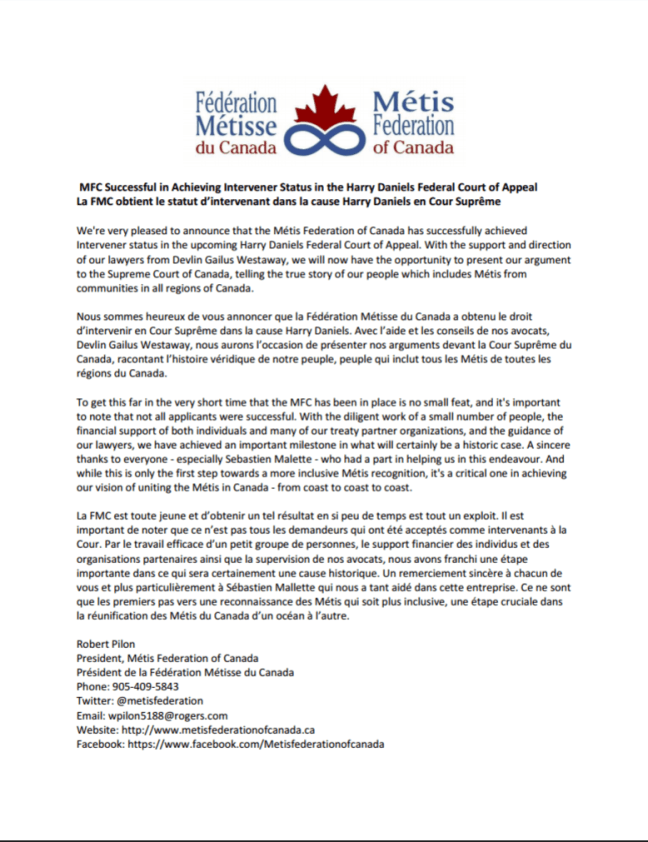
The MFC has recently been granted leave to intervene in the Daniels case

You can apply for Membership directly to the MFC by clicking this link.

The MFC is the group I decided to join. That’s my disclaimer, right there. I joined them because their philosophy corresponds to mine.

The Métis National Council

The MNC represents what they consider as

historic Métis Nation Homeland,” which includes the 3 Prairie Provinces and extends into parts of Ontario, British Columbia, the Northwest Territories and the northern United States.

They require that member’s ancestry links back to what they consider as a historic Métis Nation community, as mentioned above. 

You must apply for Membership (which they refer as Citizenship) through the MNC Governing Member in the province in which you reside. Each Registry has its own application forms and application process. I have been told that the various application processes may exclude Métis who do not reside in the same province or historical community as where their ancestors originated. 

The MNC Governing Member by province are as follows. You can click on each link representing the provincial association:

Métis Nation of Ontario                  Manitoba Métis Fédération

Métis Nation Saskatchewan **       Métis Nation of Alberta 

Métis Nation British Columbia 

Other noteworthy Associations not currently associated with the two “Federal” ones:

BC Métis Federation – Their Métis Coffee Talk, a weekly webbroadcast every Thursdays, 7:30 pst and available on-demand. Very interesting topics every week!

**Communicating with the association may be difficult, due to current issues not yet resolved.

So good luck in your search for the association that will best represent YOUR beliefs!