Tout bien considéré, il ya beaucoup de gens que je dois remercier.
Des gens qui je croyais m’aideraient à comprendre des concepts qui m’étaient nouveaux.
Des gens de qui j’aurais pu apprendre.
Des personnes qui un jour auraient enseigné mon enfant.
Mais ces gens étaiet tellement concentrés sur la poursuite d’une idéologie dont je comprends mal.
Les premières personnes vers qui je me suis tournée m’ont nié avec grande fermeté: mon identité métisse était une *erreur* de ma part, et pis encore, une fraude.
Pire, il m’accusèrent d’appropriation d’une identité Autochtone.
Mais, et surtout, on ne m’a jamais demandé ce que je savais de ma provenance, qui étaient mes ancêtres, quelle histoire orale m’avait été transmise.
J’ai décrit certaines de ces expériences dans ce blog.
Nous avons du mal à se débarasser du colonialisme en se parlant les uns aux autres, et nous demandons – plutôt – nous exigeons des preuves empiriques. L’histoire orale? Pfft.
Quoi qu’il en soit, voici ce que j’ai découvert durant mes fouilles, qui explique la relation entre les Métis de Lanaudière et les Métis de la rivière Rouge:
La page ci-dessus provient d’un livre publié en 1889 à propos de la paroisse de Berthier . La page 105 décrit l’examen des dossiers de la paroissse du Curé Jean- Baptiste -Noël Pouget , entre 1777 et sa mort en 1818. Il explique que durant cette période , un grand nombre de baptêmes d’adultes , * sauvages * et de Métis de la Territoires du Nord- Ouest .
L’explication de l’auteur est dû au confluent de nombreuses rivières autour de Berthier, qui est pourtant plus éloigné pour les Métis provenant de la région de la rivière Rouge que Montréal.
Mais les archives généalogiques démontrent que les Métis du Nord-ouest avaient de la parenté vivant le long des rivières menant à Berthier: cousins,cousines, oncles, tantes, grands-parents.
Superbe exemple d’une famille bien connue du Manitoba, la famille Henry,venue à Berthier pour baptiser leur fille. Le dossier indique clairement qu’elle est Métis (métive):
Bien que Pouget semblait être favorable aux Métis , l’Eglise décourageait les unions mixtes , ce qui peut expliquer pourquoi les parents restent sans identité. Les baptêmes ont été inscrits dans les registres comme étant né d’un père canadien et d’une mère autochtone. Presque deux douzaines de ces dossiers ont été localisés à ce jour dans les registres de l’église de Berthierville
Tiens voilà. La preuve empirique d’un lien.
Parce que les histoires orales n’étaient pas assez .
Parce que la ceinture métisse faite à L’Assomption n’était pas assez .
Parce que les souvenirs de la parenté n’étaient pas assez.
Mais encore une fois, je vous remercie. Cette expérience m’a donné l’occasionde rencontrer des gens qui ont posé les bonnes questions et de qui je pourrai apprendre durant mon cheminement. Et qui je l’espère seront autour de ma famille pour les années à venir.
le mépris que les Blancs ont porté aux Autochtones a fait obstacle à des emprunts sociaux massifs et que si, par hasard, il y avait un ancêtre autochtone dans l’arbre du Québécois moyen, il était rare et sans précédent.
Nous ne savons pas pourquoi ils ont changé leur patronyme. Peut-être qu’ils ont suivi les traditions autochtones de nos ancêtres?
Une fois que le fil des noms a été démêlé, il faut retrouver les actes religieux reliant chaque génération l’une à l’autre, jusqu’à l’ancêtre d’une Première Nation.
Mais comment prouver que des communautés historiques et contemporaines existent?
Voici quelques exemples du travail que je j’ai entrepris afin d’illustrer la présence des Métis dans la Mauricie et Lanaudière, les confluences entre les Premières Nations de la Terre de Rupert et le fleuve Saint-Laurent que les anciens appelaient “Les Pays d’En Haut”.
Je choisi un symbole de la plume d’Aigle afin d’illustrer mes ancêtres des Premières Nations et la plume du Corbeau pour illustrer chaque descendant Métis jusqu’à moi. Au fait, il y a une histoire sur la plume de corbeau et les Métis que je souhaiterais écrire un jour …
Je fais cet exercice pour trancher l’argument du quotient de 1%. C’est une tâche de longue haleine et je ne me donner aucune date limite pour la compléter, à moins que le sujet de l’existence de communautés métisses ici est une fois de plus remis en question. Si ça devait se reproduire, je mettrai à jour ce blogue pour démontrer à combien de gens de ma communauté seraient dignes de porter une plume de corbeau.
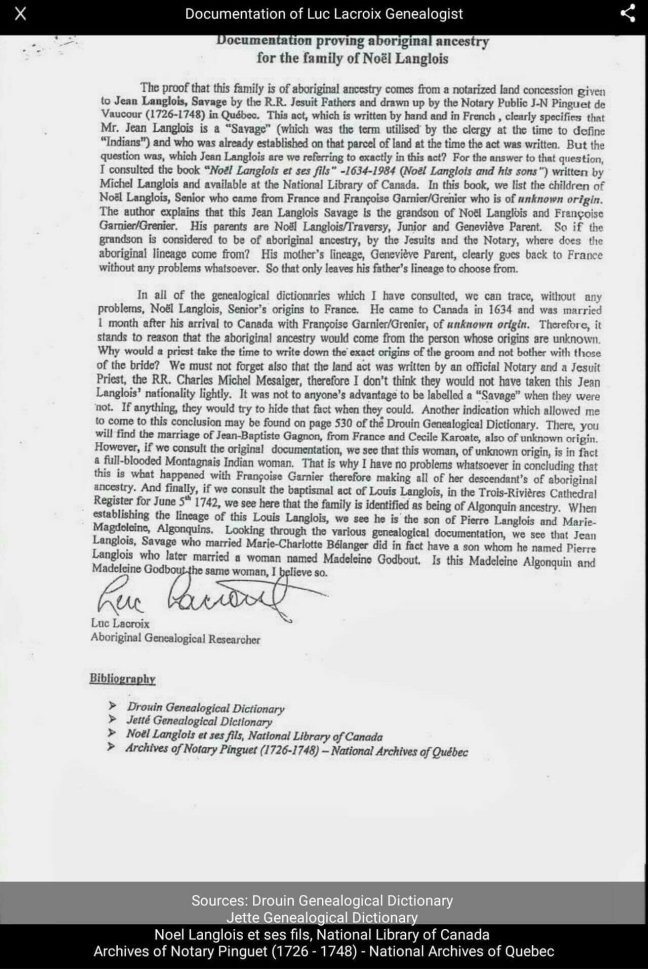
N.B. la généalogie liant à Françoise Garnier a été enlevée suite à ce les informations confirment qu’elle n’était pas autochtone, malgré l’exitence d’une lettre provenant d’un généalogiste confirmant le contraire.
In a way where patronyms keep coming back, generation after generation, weaved with one another in different combinations.
In an earlier post, I had spoken about my consternation over Sociologist Gerard Bouchard’s article he titled “The Québécois’ Fake Indian Blood” (La Presse, Feb. 7, 2015) where he discounts the Métis population of Québec, stating that contempt of Settlers towards Indigenous Peoples had massively impeded social interaction and that if perchance there was an Indigenous ancestor in the average Québecois’ tree, it was rare and unprecedented.
People changed names. A few examples, taken from my own genealogy:
LePellé / Lepelé
LaHaye / LaHaye / Lahé
DesMarais / Desmaret
Lagrave
Lamothe
All the same people
Here’s another family from my genealogy:
Pelletier
Antaya
Marolle
Gobloteur
Passavant
Laprade
We don’t know why they changed their patronym. Maybe they did follow similar Indigenous name-calling traditions?
Once the threads have been untangled, Church records need to be found linking every generation all the way back. Finding all the records going back to one First Nation ancestor.
But what about proving historic and contemporary communities existed?
Here are a few examples of the work I have undertaken to illustrate the presence of Métis in Mauricie and Lanaudière, confluences between the First Nations settlements of Rupert’s Land and the Saint-Lawrence river. The French called it “Les Pays d’En Haut” – the Upper Country.
I chose to illustrate First Nation ancestors with symbol of the Eagle feather and I used the Crow’s feather to illustrate each subsequent Métis descendant all the way to myself. There’s actually a story about the crow’s feather and the Métis that I hope to write some day…
I’m doing this exercise to put everyone’s mind to rest about the 1% blood quantum argument. It’s a time-consuming task and I’m not giving myself a deadline to do it, unless the topic of the existence of Métis communities here is once again questioned. Then I’ll update this blog and show just how many people could wear a Crow’s feather in my community.
N.B. the genealogy linking to Françoise Garnier was removed following information confirming that she was not Indigenous, despite the exitence of this letter confirming the opposite from a reputed genealogist:
Nous étiâmes déjà d’icitte, mais nous étiâmes aussi de nouvel arrivage. Nous faisions parti des colons, mais nous avions une partie indigène. Nous voulions appartenir à nous mêmes. Quelque part le long du chemin, nous sommes devenus assimilés.
Les actes parlementaires entre la mi-19ème et le 20ème siècle, débutant par la Loi sur la Civilisation graduelle de 1857, les gens ont décidé pour nous qui était et qui n’était plus considéré *indien*.
Les grands-parents sont décédés, les parentés ont perdu le contact avec l’un l’autre, la vallée entre les familles métisses et des Premières nations s’élargit à chaque génération supplémentaire qui nous sépare de nos ancêtres. Le temps a passé, des efforts ont été faits pour cacher l’histoire orale nous reliant. La vie déroba nos racines.
Ils ont essayé d’oublier que nous étions autochtones.
Ceux d’entre nous qui avaient entendu parler de l’histoire orale avaient peu de moyens pour les aider à relier les points. Nous étions occupés à aller à l’école colonialiste, obtenir des emplois colonialistes, élever nos enfants dans le colonialisme. Le colonialisme prit tout notre temps.
Nous sommes *presque* devenus le succès de la doctrine de John A. MacDonald qui voulait «tuer l’Indien, sauver l’homme».
Presque.
Ceux d’entre nous, pour qui les souvenirs de l’histoire orale ont été tissés dans nos rituels, nous nous sommes souvenus. Nous avons connu les rituels de placer le tabac que nous avions cultivé dans nos jardins, lorsque nous récoltions la ligne de trappe. Nous avons remercié le Créateur à chaque fois nous avions récolté de la chasse, du potager, des rivières. Nous ne passions jamais devant un feu en plein air sans nous purifier de sa fumée
Nous nous sommes souvenus.
Ceux d’entre nous, qui avions célébré en famille dans nos communautés et liée par les habitudes de nos kokoms indiennes éloignées, séparées par des générations, nous nous sommes souvenus. Les refrains des chansons à répondre, les pas de gigue, l’odeur de la nourriture traditionelle et certains temps de l’année sont les déclencheurs d’inondations de souvenirs, chacun de nous se complétants les uns et les autres quand nous nous revoyons.
Pourquoi nos grands-parents n’ont pas affirmé notre indigénéité? LA CRAINTE.
La crainte qu’ils ont vécue et qu’ils nous ont communiquée.. Ils avaient directement subis les effets des évènements.
J’ai toujours su que la famille de mes grands-parents se sont dispersés à la fin du 19ème siècle. Certains sont allés plus au nord (Abitibi) certains sont descendus vers le sud (les factories du Massachusetts). Certains sont revenus, certains n’ont jamais remis pieds sur Lanaudière. Ce qui a été presque jamais été discuté fût la raison de l’exode.
En parlant avec des membres de la famille – qui – comme moi, étaient assez jeunes pour avoir pu témoigner directement des réponses évasives de nos grands-parents, nous avions compris qu’il y avait une peur derrière ce qu’ils ont choisi partager et ce qu’ils ont choisi d’essayer oublier.
Mes grands-parents ont été témoins des événements de la rivière Rouge (1869 au 1870) et de Batoche (1885). Les personnes touchées étaient leurs parents directs: leurs cousins au premier ou deuxième degré, leurs tantes et leurs oncles, les tantes et oncles de leurs parents. Ils n’étaient pas isolés des effets de la Rébellion de la rivière Rouge. Leurs propres parents avaient vécu leur propre rébellion 50 ans auparavant (de 1837 à 1838). Du début à la fin, 48 années de rébellions, Avec beaucoup de lois écrites entre les deux: la Loi sur la Civilisation graduelle (1857), la Loi sur les Indiens (1867) et tous ses amendements, la Loi de l’émancipation graduelle (1869).
Les Scrip du Nord-Ouest visant à éteindre le titre autochtone des habitants de l’ouest. (1870 à 1920). Les traités numérotés. (1871-1921).
Des lois servant à nous *civiliser* et des lois servant à nous emprisonner.
Les choix faits par mes ancêtres provenaient de deux options reflétant les objectifs des gouvernements colonialistes. Abandonnez une réclamation d’indigénéité ou faire face à une ségrégation sur des terres qui étaient – sur papier – censé être réserver pour l’usage exclusif des Premières nations, mais qui sont rapidement devenues des prisons en plein air pour ceux qui ne pouvaient pas ou ne voulaient tout simplement pas assimiler.
Dans les années 1960, les choses ont semblés commencer à s’améliorer. Mais la génération de mes grands-parents avainet dû composer avec un grand sentiment de culpabilité.
Culpabilitésur leurs propriétés foncières, la culpabilité au sujet du vote. La culpabilité de leurs conditions de vie par rapport à celles de leurs cousins éloignés. La culpabilité de savoir qu’il existait des agents des Indiens, et la culpabilité d’avoir acquiescé à la ségrégation des Premières nations.
Trois, quatre et même cinq générations passées ont abouti avec l’élargissement du fossé entre les Métis d’ici et notre parenté dans l’ouest.
Dans les années 1980, certains d’entre nous savions que beaucoup de familles Inuit et des Métis dans l’Ouest avaient vécu un traitement similaire au traitement que nous avons vus dans les réserves où vivaient les arrières-petits-enfants de nos ancêtres des Premières nations.
Mon père et moi parlions souvent des inégalités des peuples autochtones. Avant l’Internet (ben oui, c’est arrivé!), cette connaissance était limitée à des contacts directs lors de voyages et vivant dans d’autres communautés. Les médias avaient rarement rapportées des nouvelles sur les conditions de vie des Premières nations, des Inuits et des Métis. Il n’y avait pas beaucoup de moyens pour obtenir des informations.
Je porte toujours la culpabilité de mon apparentée Métis et mes ancêtres Métis qui est multiplié par chaque génération qui ont été témoins des effets du colonialisme et de ses traumatismes résultant.
Nous avons renoncé à nos terrains de chasse et tout autre droits tacites résiduels aux gouvernements municipaux, provinciaux ou fédéraux dans les années 1970, parce que nous croyions que les gouvernements colonialistes agissaient dans l’intérêt collectif. Nous avions partagé nos traditions avec tout le monde – coloniaux ou non – parce que nous avons pensé que c’était la bonne chose à faire.
Nous aurions dû intervenir,
nous aurions dû faire plus.
Nous aurions dû résister.
Nous aurions dû dire «non»
Vers la fin des années 1970, il semblait que le plan de MacDonald a presque fonctionné. Li Gens Libres n’étaient plus.
Je ne jugerai pas mes grands-parents trop sévèrement, car je sais que sans recul, tout avait l’air bon, et qu’ils faisaient ce qu’ils pouvaient dans les circonstances que je ne pourrai jamais saisir pleinement.
Aujourd’hui et depuis un certain moment déjà, je travaille à réaffirmer l’indigénéité de mes ancêtres. Je le fais dans fraternité et en solidarité avec tous les peuples autochtones et les personnes qui ont souffert. Personnellement, je ne demande rien, mais j’offre mon soutien et ma compréhension des torts causés aux nôtres par le colonialisme.
We were already here, but we had also newly arrived. We are part Settler, part Indigenous. We wanted to Own Ourselves. Somewhere along the way, we became assimilated.
Acts between the mid-19th and 20th Century, beginning with the Gradual Civilization Act of 1857, people decided for us who was and who were no longer considered *Indian*.
Common grandparents died, kinships lost touch with each other, the valley between Métis families and First Nations widened with each additional generation separating us from our ancestors. Time passed, efforts were made to hide the oral history of our connections. Memories faded.
They tried to make us forget we were Indigenous.
Those of us who had heard the oral history firsthand had little ways of connecting the dots. We got busy going to Colonialist schools, getting Colonialist jobs, raising our kids in Colonialism. Life happenend.
We *almost* became the success of John A. MacDonald’s doctrine to “kill the Indian, save the Man”.
Almost.
Those of us, for whom the memories of oral history was woven into our rituals, we remembered. We experienced the rituals of laying down tobacco we cultivated in our gardens, when we harvested from the trap line. We gave thanks every time we harvested from the hunt, from the garden, from the rivers. We never walked by a smoky open air fire without smudging.
We remembered.
Those of us, who celebrated in our communities with kin and linked by our far removed Indian kokoms, separated by generations, we remembered. The sound of the reels, and the steps of the jigs, the smell of the food and certain times of the year are triggers of floods of memories, each of us completing the other when we reconnect.
Why did our great-grandparents not assert our Indigeneity? FEAR.
FEAR was lived and was communicated by them. They had directly experienced the effects of the bad stuff.
I’ve always known that my great-grandparents’ families dispersed at the end of the 19th century. Some went further North (Abitibi) some went South (Massachusetts). Some came back, some never did. What was hardly ever spoken was the reason for the exodus.
Speaking with family members – who – like me, were young enough to bear direct witness to our great-grandparents’ evasiveness, we understood that there was fear behind what they shared and what they chose to try to forget.
My great-grandparents bore witness to the events coming from the Red River (1869-1870) and Batoche (1885). The People affected were their direct kin: their first, or second cousins, their aunts and oncles, the aunts and oncles of their parents. They weren’t isolated from the effects of the Red River Rebellion. Their own parents had lived their own Rebellion 50 years before (1837-1838). 48 years of Rebellions, between start to finish. With alot of laws in between: the Gradual Civilization Act (1857), the Indian Act (1867) and all its amendments, the Gradual Enfranchisement Act (1869).
The North-West Scrips to extinguish Aboriginal title. (1870s to 1920s). The Numbered Treaties. (1871 to 1921).
Acts to *civilize* us and Acts to entrap us.
The choices my ancestors made stemmed from two main options reflecting the Colonialist governments. Give up claim of Indigeneity or face segregation in these lands that were, on paper, supposed to be *given* to First Nations to occupy, but quickly became prisons for those who couldn’t or wouldn’t Assimilate?
By the 1960s, things started to look up. But by then, my grandparents’ generation had to deal with GUILT.
GUILT of land ownership, GUILT about voting. GUILT over their living conditions as compared to their distant cousins. GUILT over the knowledge of Indian Agents, and GUILT over the removal of First Nations kin.
By then, 3, 4 or even 5 generations had resulted in widening the gulf between Métis here and our kin out West.
By the 1980s, some of us knew that many Inuit and Métis families out West had experienced so much of the same treatment we witnessed in reserves where our First Nations ancestors’ great-grandchildren lived.
My father and I often talked about the inequalities of Indigenous Peoples. Prior to the Internet (as there was such a time!), such knowledge was limited to direct contacts made through traveling and living in other communities. The media rarely reported of the living conditions of First Nations, Inuit and Métis communities. There wasn’t many ways to obtain information.
I still carry the guilt of my Métis kin and my Métis ancestors that is multiplied with every generation to have had to bear witness of the effects of Colonialism and its resulting trauma.
We should have stepped in.
We should have done more.
We should have stood up.
We should have said “no”.
We gave up our hunting grounds and whatever residual, unspoken rights to municipal, provincial or federal governments by the 1970s, because we believed that the Colonialist governments were acting in the collective interest. We shared our traditions with everyone – Settler or not – because we thought it was the right thing to do.
By the late 1970s, it almost looked like MacDonald’s plan worked. Li Gens Libres weren’t.
I won’t judge my great-grandparents too harshly, as I know that hindsight isn’t 20/20, and that they did what they could under circumstances that I will never be able to fully grasp.
Today and for a while now, I work at reaffirming mine and my ancestors’ Indigeneity. I do it in fraternity and solidarity with every Indigenous Peoples and Persons that have suffered. I personally demand nothing, but offer my support and my understanding of the wrongs done by Colonialism to our Own.
Suite aux évènements choquants à Val d’Or, et afin de supporter et rallier nos communautés Autochtones du Québec, je propose que nous lisons chacun et chacunes un des 94 appels à l’action de la Commission de vérité et réconciliation.
Si vous désirez participer, communiquez avec moi à Qallunette@gmail.com ou @Qallunette sur Twitter, et je vous assignerai une des recommandations.
Filmez-vous en vous présentant, nommant votre communauté et lisez le passage de la recommandation.
Téléchargez votre vidéo sur YouTube ici: portant la mention #CVRAppelsàl’action et le numéro de la recommandation.
Le rapport complet a été lu en Anglais, vous pouvez le voir ici: (Grand merci à Zoe S. Todd, Erica Violet Lee, Joseph Murdoch-Flowers pour l’organisation de ce beau geste de solidarité, ainsi qu’à Chelsea Vowel pour l’inspiration – Migwetch!)
Suite aux évènements choquants à Val d’Or, et afin de supporter et rallier nos communautés Autochtones du Québec, je propose que nous lisons chacun et chacunes un des 94 appels à l’action de la Commission de vérité et réconciliation.
Si vous désirez participer, communiquez avec moi à Qallunette@gmail.com ou @Qallunette sur Twitter, et je vous assignerai une des recommandations.
Filmez-vous en vous présentant, nommant votre communauté et lisez le passage de la recommandation.
Téléchargez votre vidéo sur YouTube ici: portant la mention #CVRAppelsàl’action et le numéro de la recommandation.
Le rapport complet a été lu en Anglais, vous pouvez le voir ici: (Grand merci à Zoe S. Todd, Erica Violet Lee, Joseph Murdoch-Flowers pour l’organisation de ce beau geste de solidarité, ainsi qu’à Chelsea Vowel pour l’inspiration – Migwetch!)
All things considered, there are many people I need to thank.
People who I expected to help me understand concepts that were new to me.
People who I can learn from.
People who would possibly one day teach my own child
People that have been so focused on pursuing an ideology I have difficulties understanding.
The first people I turned to were blunt: my Métis identity was akin to fraud.
Worse, it was Indigenous Appropriation.
But, and very importantly, they never asked me what I thought I knew about where I come from, who my ancestors are, what oral history was passed to me.
I have written in past posts about such experiences, and have Storified some, Here are a few examples:
“Discussion on rights to (re)claim Métis identity” part one and part deux
And there were more…
We have a hard time shedding Colonialism when speaking to each other, and request – nay – DEMAND empirical proof. Oral history? Pfft.
Anyways, here’s what I found, explaining the relationship between Métis of Lanaudière and Métis of the Red River:
The page above is from a book published in 1889 about the Parish of Berthier. Page 105 is a review of the Church records during the tenure of Jean-Baptiste-Noël Pouget, between 1777 and his death in 1818. It explains that during this period, a great number of baptisms of adults, *savages* and métis from the North-West territories.
The author’s explanation is the confluence of the many rivers surrounding Berthier, which is situated fairly East of Montreal – which would have been much closer to the Métis coming from the Red River area.
But genealogical records can show that the North-West Métis had kinship living along the rivers leading to Berthier: first cousins, uncles, aunts, grandparents.
A stunning example of a well-known family from Manitoba, the HENRY, who came to Berthier to have a daughter baptized. The record clearly indicates that she is Métis:
Although Pouget seemed sympathetic to Métis, the Church discouraged mixed unions, which may explain why the parents were never named. The baptisms were entered in the records as born of a Canadian father and an Indigenous mother. Almost two dozen of such records have been located so far in the Berthierville church records.
So, there it is. The empirical proof of a link.
Because the oral histories weren’t enough.
Because the Métis sash made in L’Assomption wasn’t enough.
Because the kinship memories weren’t enough.
But again, thank you. This experience has given me the opportunity of meeting people that do care, who I can learn from. And who I hope will be around my daughter for years to come.
For some time now, there’s been discussions about the ethnogenesis of the Métis People of Canada. There are many opinions, and many people have much to gain for people currently not included in the definition of Métis as described by the Métis Nation of Canada.
I won’t speak about other narratives and I won’t arrogate an opinion on others. Although I benefit of the Privilege of being a White-passing Métis, I strive to decolonize my mindset every day.
Why? Because I heard them first-hand, they were oral and when I’m no longer here, I want it documented. It’s important to me for my children, my future grand-children and my future great-grand-children for so many reasons, and “oral narratives” are discounted. So I’m writing them down, here. Nobody else need to agree with me. I’m not the Courts and it’s not a debate.
Identity is a moving target, and I’ve seen many Indigenous groups having to resort to historical documents because their identity relies on Court decisions. To me, it is the most Colonialist gesture enabling the erasure and assimilation of Indigenous minority groups. To me, it’s like a little bit of Indigenous Persons living on the fringe gets cut off every time the numbers of that group gets small enough not to benefit from research or pecuniary interest.
I have serious doubts on whether my own “small” community will ever be recognized as historical either. Because it’s in Québec, and because my community’s narrative is too often hijacked by Québec Nationalists to strengthen an argument of French as “Original Peoples” – i.e. here before British Colonialism for the purpose of Sovereignty…
Sigh. I’ve got so much to say about that. But, to be brief: not all people from Québec identify as Métis, have ancestors who were *Indians, are from a historical community. And last, but not least, not all Métis of Québec identify as Québécois.
Again, only speaking for myself here: I don’t, nor have I ever, identified as Québécois. The ways in which I have understood my family’s history has always led me to understand that my identity was more *fluid* (for lack of a better word) than just Québec. My ancestors and their kin were travelers. Voyageurs. They were impervious to borders that shifted so much prior to Confederation.
They came and they went. They traveled for the fur trade. They came back. They eventually settled. They didn’t settle along the Red or the Assiniboine Rivers. They chose other rivers: Saint-Maurice, Mastigouche, L’Assomption, Bayonne, Ouareau, moving up the rivers away from the population growth along the Saint-Lawrence.
It’s gonna be hard to prove to the Courts that Lanaudière and/or Mauricie are historic communities, because there’s nothing to gain. No oil, no natural gas, no bituminous sands. Just water and forests and farmland. Representation needsmoney (I’m hearing Kevin O’Leary yelling this), and money expects a return on its investment.




 Les écrits d'une ♾Abitawiskwe♾ and her writings