Les multiples noms des Métis: un peu plus sur l’origine du Chicot

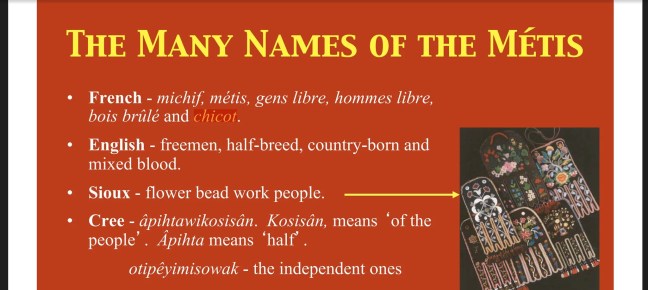
En tant que document d’accompagnement d’un blog précédent: Iles Dupas et du Chicot , je veux partager avec vous les origines du terme parfois utilisé pour désigner les Métis.

IMG_20160714_204756
source: http://www.metisnation.org

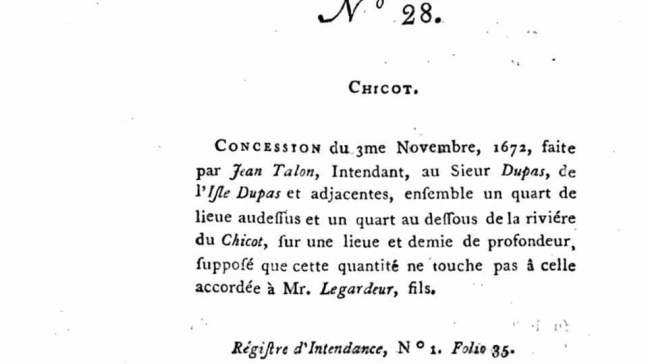
Auparavant mentionné, mes aïeux Jacques BRISSET et Louis DANDONNEAU étaient les détenteurs de la seigneurie:

received_10154497119204059
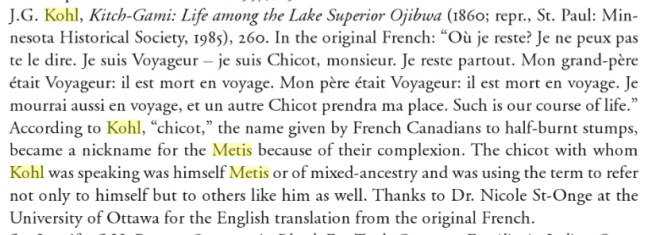
Le nom Chicot a été documenté en 1860, lorsque Johann G. Kohl a décrit dans un passage de son livre: Kitch-Gami, Vie Parmi les Ojibwés Lac Supérieur dans lequel il raconte sa discussion en français avec un homme métis qu’il rencontrait lors de ses voyages:

Studio_20160715_140151
En l’absence d’autres informations, Kohl et beaucoup après lui déduit que Chicot signifiait sa traduction française comme “souches mi-brûlées”, et associé avec le teint des Métis qu’il rencontrait.
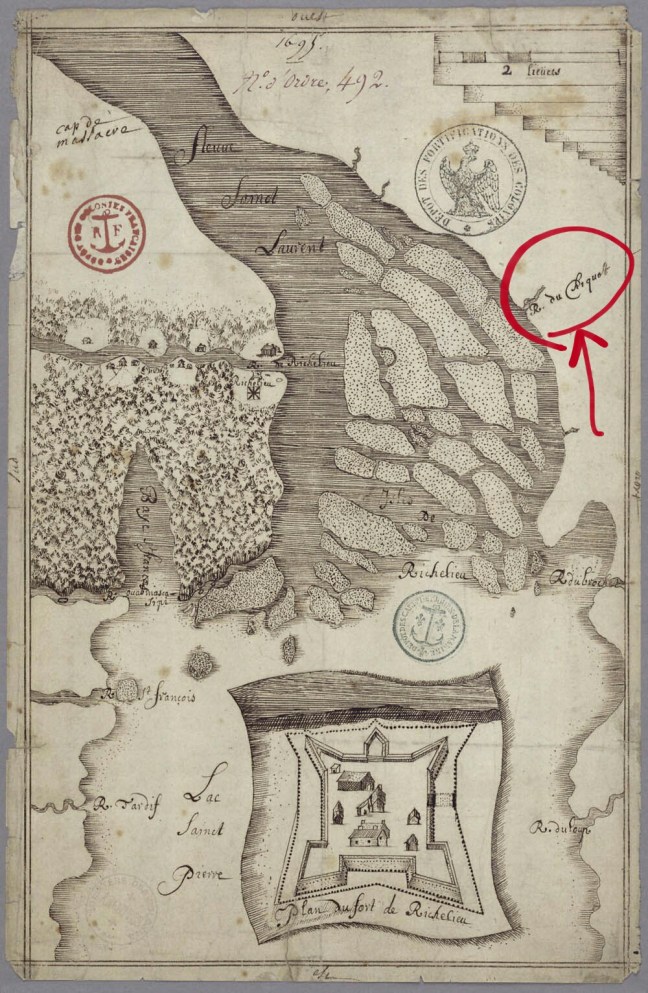
Chicot, comme beaucoup de noms donnés aux Peuples Autochtones tels que Nipissing, Ahousat, Yellowknives, Mississaugas etc., est en fait un nom de lieu. Chicot est une rivière qui se jette dans l’archipel entre Trois-Rivières et Montréal, entre Berthier et Sorel à l’île Dupas.
Studio_20160715_143550
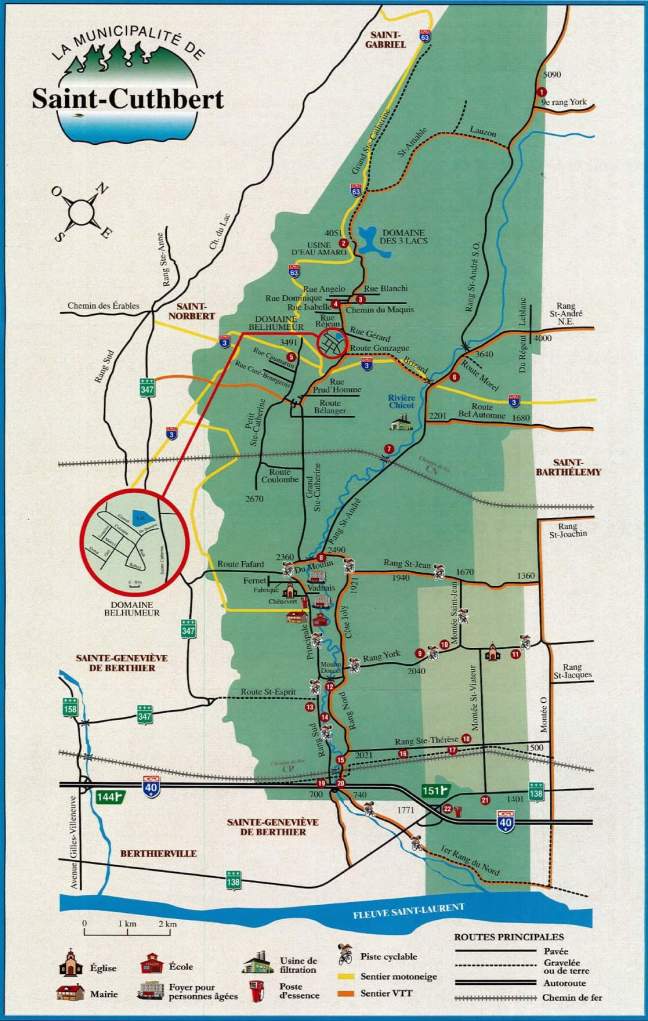
La rivière Chicot, en amont, prend son départ entre St-Gabriel de Brandon et St-Didace court en direction Sud à travers les communautés de St-Cuthbert, Saint-Norbert et se décharge dans le Saint-Laurent à l’île Dupas. Il est l’un des nombreux cours d’eau utilisés par les Voyageurs, ayant connus sa navigation à partir de leurs famille des Premières Nations. Comme les îles et les villes voisines étaient devenues bondés de colons attirés par le poste de traite à proximité, les Métis et les Premières Nations pagayèrent leur chemin en amont et se construsirent des communautés le long de ses rives.

Studio_20160715_144546

received_10154497119214059
Il est remarquable de souligner les noms des communautés qui ont été utilisés par les Chicots lorsqu’ils s’installèrent dans les communautés le long de la rivière Rouge dans ce qui est devenu le Manitoba: «Brandon» et «St-Norbert».

Le Centre du patrimoine au Manitoba, gardien du patrimoine francophone et métis de l’Ouest canadien a récemment souligné que la municipalité de Taché, Manitoba a récemment reconnu l’importance de Saint-Cuthbert non seulement comme lieu d’origine de sa famille mais aussi comme lieu d’origine de plusieurs familles. Cliquez ici pour plus d’informations

Studio_20160715_161650
Enter a caption

Extrait:

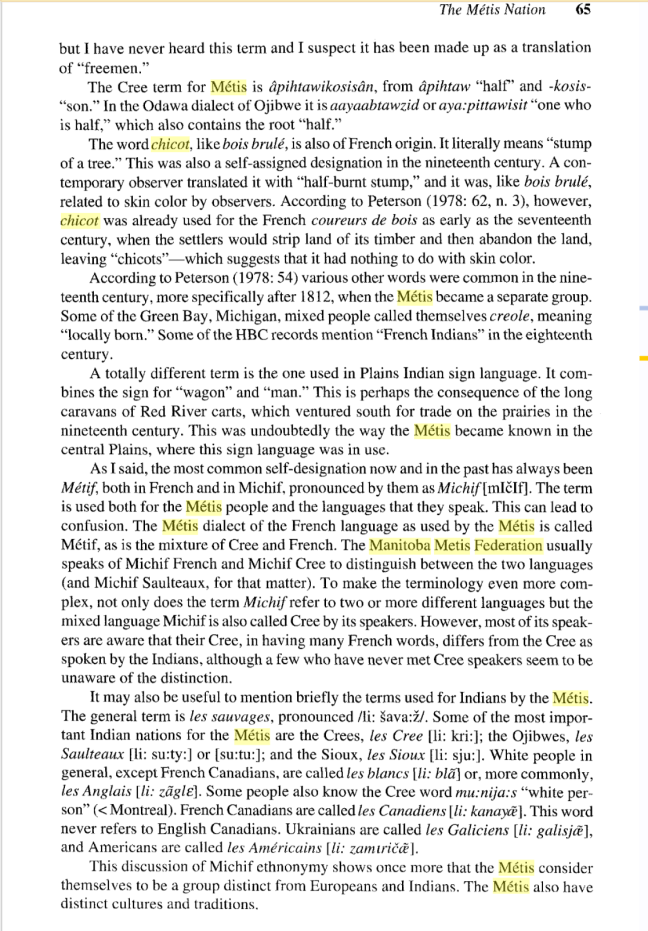
Une Langue of à Nous: La genèse du michif, la langue crie mixte-française des Métis du Canada, Peter Bakker, Oxford University Press, 5 juin 1997

Autres lectures: (version française non-disponible – titres traduits à titre informatif seulement)

Kitchi-Gami: la vie parmi les Ojibway, Johann Georg Kohl, St.Paul: Minnesota Historical Society Press, 1985

One of the Family: Métis Culture in Nineteenth-Century Northwestern Saskatchewan, Brenda Macdougall, UBC Press, 1 janvier 2011

Contours d’un peuple: Metis famille, mobilité et d’ histoire, Nichole St-Onge, Carolyn Podruchny, Brenda Macdougall, University of Oklahoma Press, 18 déc 2014

Foire aux questions, Métis Nation of Ontario (cliquer pour le lien –en Anglais seulement)
The Many Names of the Métis: here’s more about Chicot

As a companion piece of a previous blog: Iles Dupas et du Chicot, I want to share with you the origins of the term sometimes used to designate Métis.

As previously mentioned, Jacques BRISSET and Louis DANDONNEAU were the holders of the title to the area:

received_10154497119204059

The name Chicot was later documented in 1860, when Johann G. Kohl wrote a passage in his book: Kitch-Gami, Life Among the Lake Superior Ojibwa in which he retells his discussion in French with a Métis man he encountered during his travels:

Studio_20160715_140151

With no other information, Kohl and many after him deduced that Chicot meant its literal translation from French as “half-burnt stumps”, and associated it with the complexion of the Métis he met.

Chicot, like many names given to Indigenous Peoples such as Nipissing, Ahousat, Yellowknives, Mississaugas etc., is in fact a place-name. Chicot is a river that runs into the archipelago between Trois-Rivières and Montréal, between Berthier and Sorel and known today as île Dupas.

Studio_20160715_143550

The Chicot travels downstream, beginning between St-Gabriel de Brandon and St-Didace and flows South through the communities of St-Cuthbert, St-Norbert to discharge into the Saint-Lawrence at île Dupas. It is one of the many rivers used by Voyageurs, who learned to navigate it from their First Nations kin. As the islands and neighbouring towns became crowded with Settlers attracted to the nearby trading post, Métis paddled their way upstream and built communities along its shores.

Studio_20160715_144546

received_10154497119214059

It is noteworthy to highlight the names of the communities that were used by Chicots who set up communities along the Red river in what became Manitoba: “Brandon“, “St-Cuthbert” and “St-Norbert“.

Studio_20160715_161650

Excerpt from:

A Language of Our Own: The Genesis of Michif, the Mixed Cree-French Language of the Canadian Métis, Peter Bakker, Oxford University Press, Jun 5, 1997

Further readings:

Kitchi-Gami : life among the Ojibway, Johann Georg Kohl, St.Paul: Minnesota Historical Society Press, 1985

One of the Family: Metis Culture in Nineteenth-Century Northwestern Saskatchewan, Brenda Macdougall, UBC Press, Jan 1, 2011A Language of Our Own: The Genesis of Michif, the Mixed Cree-French Language of the Métis, Peter Bakker, Oxford University Press, Jun 5, 1997

Contours of a People: Metis Family, Mobility, and HistoryNichole St-Onge, Carolyn Podruchny, Brenda Macdougall, University of Oklahoma Press, Dec 18, 2014

Frequently Asked Questions, Métis Nation of Ontario  (click for link)


#Decolonization of #Métis Identity

What parts of a whole does a Métis make?

Is it Scrip? Treaty? Constitution? Law? Acts? What is the common thread of these terms? Well, they were all written by Settlers.

Is it Community? Well, Settler Courts have had to determine whether a community really “exists”, usually through harvesting and/or Land Claims.

Is it blood quantum? I don’t know. Although it could provide *empirical proof*, history has shown that blood quantum theory hasn’t worked in favour of Indigenous Peoples and other minorities in the past. And, well, it’s kind of offensive to me to think of having to give a dna test to prove I’m Indigenous…

Is it based on historical events? If so, will those events be selected by consensus, by politics, by Settler-based rules?

Is it going to be a concession to a majority who screams the loudest? A minority that needs to be protected?

Is it Self-Identification? I think that may be a start. But it’s obviously not everything, otherwise everybody could jump on the Indigenous wagon – and there’s a lot to unpack in that baggage bundle, right?

Many fields in Academia are presently studying the important question surrounding the definition of Who is a *real* Métis. Sociology is looking at the Social construct of Métis communities and try to define an ethnogenesis. Anthropology is looking at linguistic, sociocultural, biological, and archaeological workings of Métis communities. History is pouring over books and documents and Law is looking at precedence.

Academia needs money. From the buildings to the bodies, research demands funding, time and help. Where does the money come from? What is expected in return?

I need not, nor want any of those things. I keep it because my genealogy was given to me. It shows that many different  branches tie back to the same First Nation ancestors, showing how the community developed.

In addition to these direct ancestors, I have also documented their siblings when I could, to show that other communities evolved from close kin connections. It is interesting to read birth and marriage records to see the names of witnesses that were often neighbours that could trace their ancestry to the same First Nation ancestor!

I think that genealogy – which, to me, is the naming of those who came before us (manitoweyimiwew in Cree,

aanikoobijigan in Anishinaabe,

iethihsothó:kon in Kanien’kéha) is an act of Decolonization.

The debates are heated, often violent – and, as I have mentioned before – really reflective of the influences of Settlers.

Let’s move on. There’s lots of work to be done.