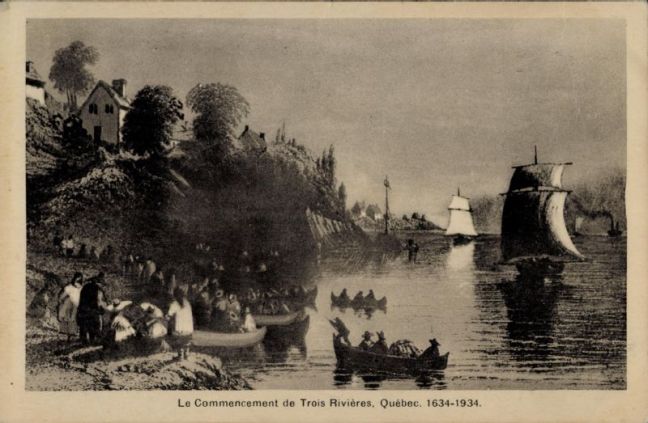
Trois-Rivières: unceded land of the Algonquin Nation

There are unresolved land claims linked to particular long-ago ancestors in the region where I live. The land was stolen by the government with no Treaty, agreement, arrangement, or compensation exchanged for the land.

In 1648, Algonquin leader Tchi8ant8, baptized as Charles Pachirini, was granted land for him and his clan at Three Rivers.

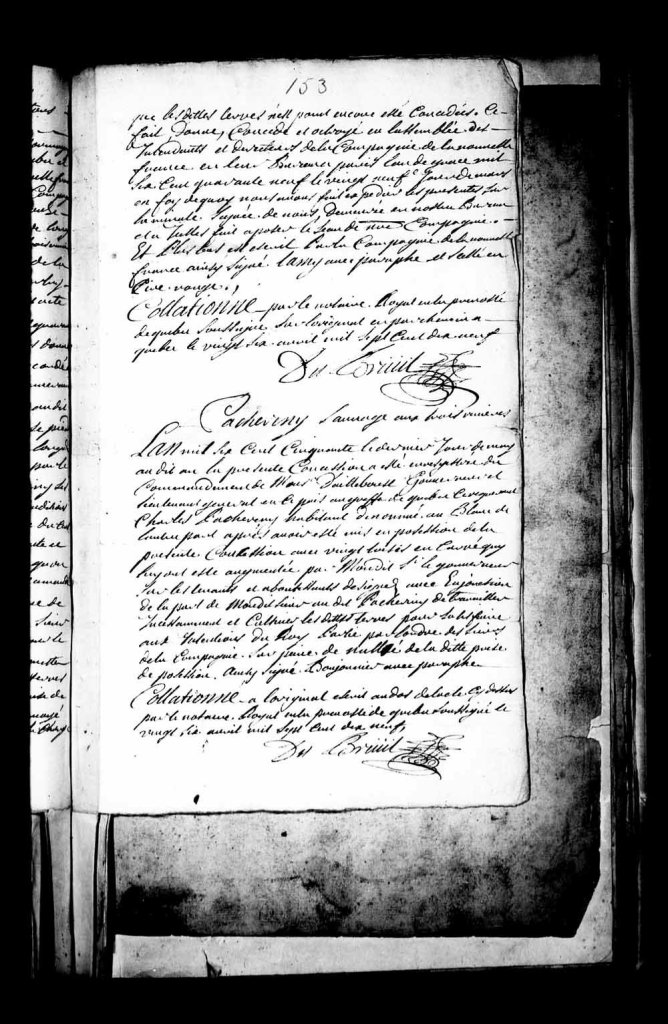
1650 Minutes of possession of land located at Trois-Rivières and registration of its titles by Louis d’Ailleboust, Governor of New France, which land belonged to Charles Pachiriny (Pachirini), Indian of the Three Rivers Source: Procès-verbal de mise en possession d’une terre sise aux Trois-Rivières et d’enregistrement de ses titres par Louis d’Ailleboust, gouverneur de la Nouvelle-France, laquelle terre appartenant à Charles Pachiriny (Pachirini), Sauvage (Amérindien) des Trois-Rivières
Source:
PY – 31 mai 1650 – 26 avril 1719
Y2 – 2022/03/23
AV – BAnQ Québec
M2 – Fonds Intendants
CN – 03Q,E1,S4,SS2,P288-4
UR – https://numerique.banq.qc.ca/patrimoine/details/52327/3314986

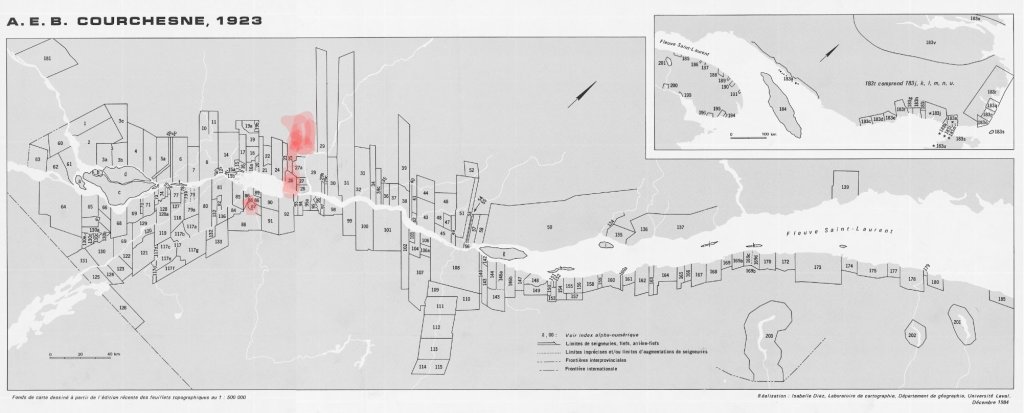
However, from 1656, the Jesuits granted lots to French settlers. By 1663, Pachirni & family had hardly any land left.

Framed: 1650 Algonquin land grant;
Shaded: Algonquin land by 1663

A few years after Pachirini’s passing, the Governor of France gave to the Jesuits whatever was left of the Algonquin parcel of land at the Three Rivers, without consent nor negotiation with the Algonquin Nation.
Here’s the 1699 contract, transcribed and translated.

Despite this acknowledgement and agreement, no further action was undertaken to return land nor compensate the Algonquins of the Three Rivers.

In 1795, Nicholas Montour, great-grandson of Pachirini’s clan member Marie Mite8agami8k8e, began to purchase the rights the two first of four Seigneuries: Tonnancourt, also known as Pointe-du-Lac, situated just East of Three Rivers on the shores of Lac St-Pierre and the adjoining Seigneurie of Gastineau, where the towns of Louiseville and Yamachiche, as well as the small Seigneuries of Pierreville, where is today the town of Pierreville and Deguise (Saint-David), today Drummondville, on the South shore of the Saint-Lawrence river.

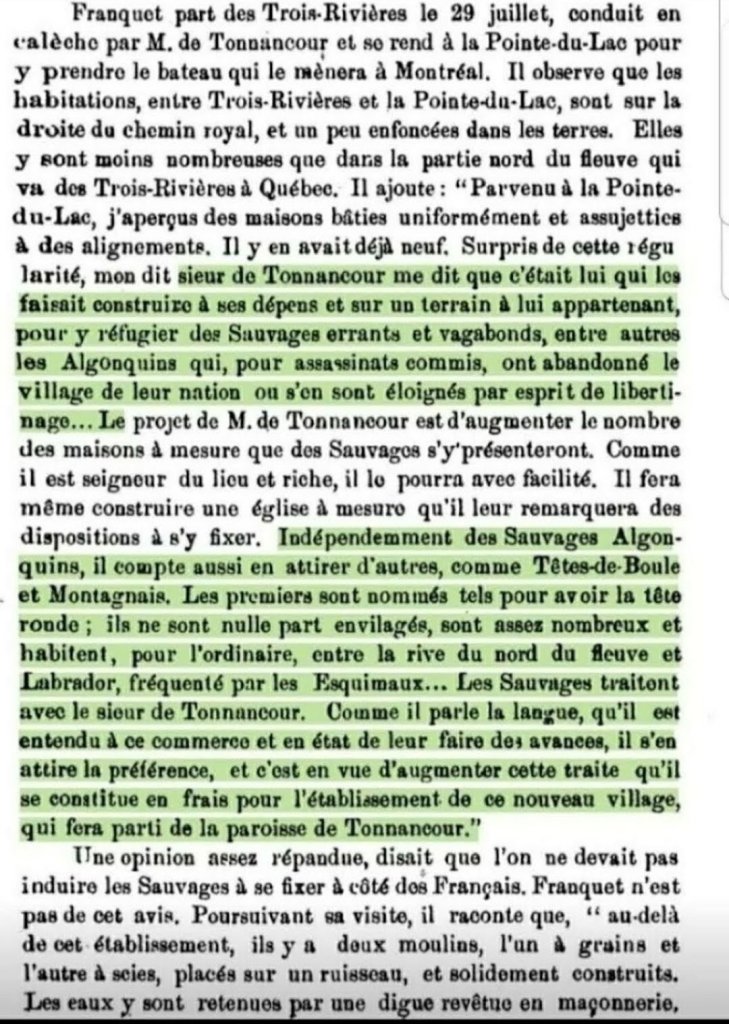
Narratives of the time show Montour spent considerable money – Settlers qualified foolishly – to build houses for “errant Savages”

Translation of highlighted text: “the said Sieur de Tonnancour told me that it was he who had them built at his expense and on land belonging to him, to take refuge there for wandering and vagabond Indians, among others the Algonquins who, for assassinations committed, abandoned the village of their nation or moved away.” “he also counts on attracting others, such as Têtes-de-Boule and Montagnais. The former are named such for having round-headed, they are nowhere envilaged, are fairly numerous and usually live between the north bank of the river and Labrador, frequented by the Eskimos… The Indians deal with the Sieur de Tonnancour. As he speaks the language, as he is understood in this trade and in a condition to make advances to them, he attracts the preference, and it is with a view to increasing this trade that he constitutes himself in expenses for the establishment of this new village, which will be part of the parish of Tonnancour.”

Fast forward to 1829, the Algonquin Nation was still trying to claim land to feed its citizens, as shown by a series of correspondences with the Indian Department of Québec.

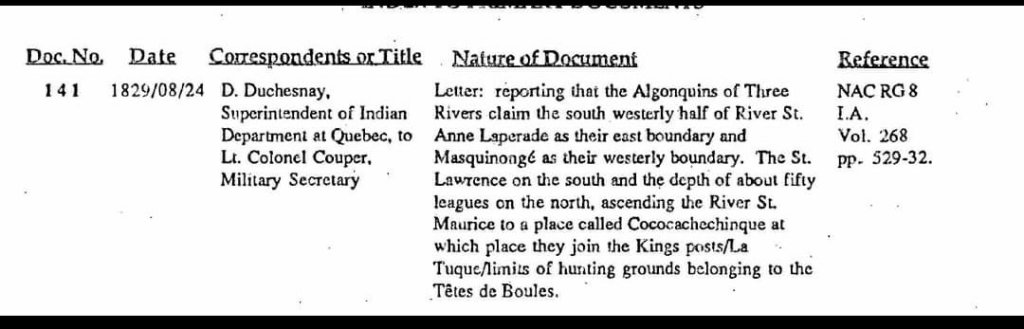
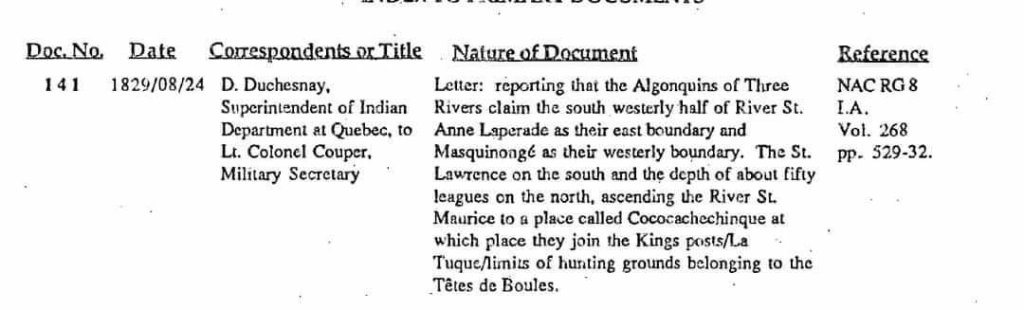
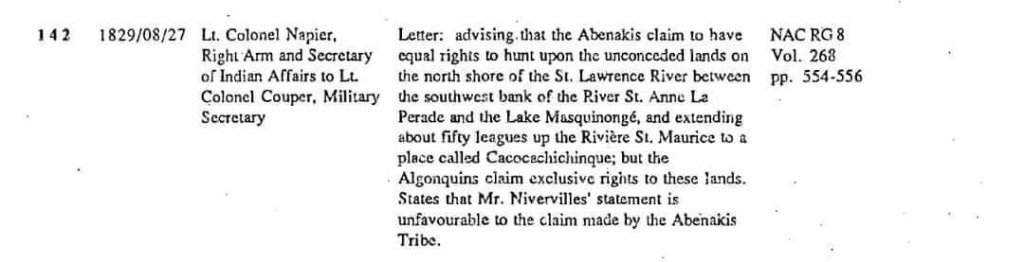
Letter: reporting that the Algonquins of Three Rivers claim the southwesterly half of River St.Anne Laperade as their east boundary and Masquinongé as their westerly boundary. The St. Lawrence on the south and the depth of about fifty leagues on the north, ascending the River St. Maurice to a place called Cococachechinque at which place they join the Kings posts/La
Tuque/limits of hunting grounds belonging to the Têtes de Boules.
Source: NAC RG 8 I.A. Vol. 268 PP- 529-32.

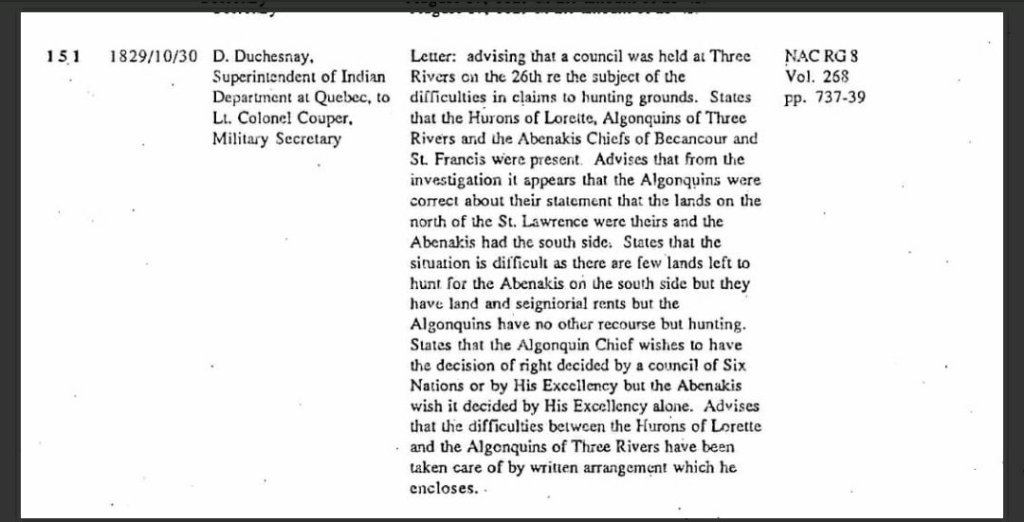
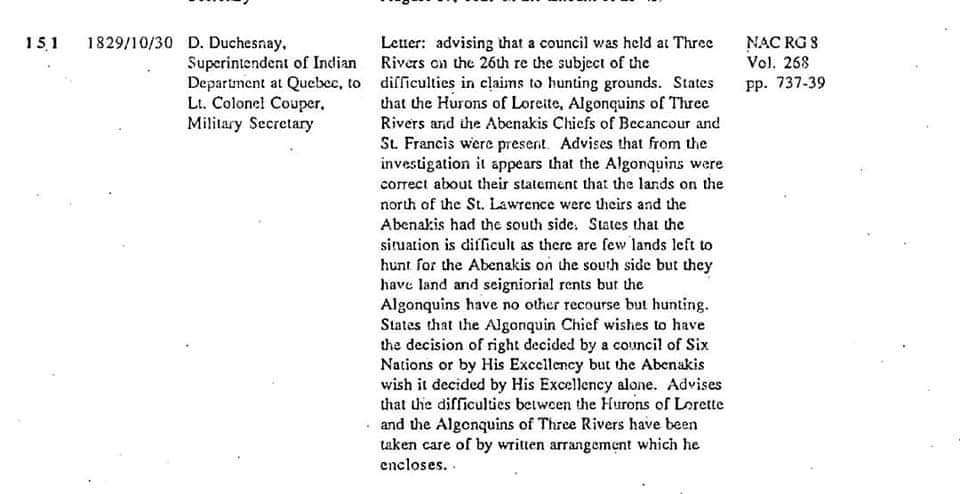
In the next correspondence by Duchesnay, Superintendant of Indian Departmenr of Quebec, to Lt. Colonel Couper, Military Secretary, dated October 30, 1829, The Indian Department acknowledged that the neighboring Abenaki and Huron-Wendat were in agreement with the Algonquin land claim.

It appears obvious from these records and as well as by research into 20th century literature, that despite the loss of the land, the Algonquin Nation, who prefer to be called Metabenutin Uininis, remain in the vicinity of Three Rivers, despite non-recognition by either federal or provincial governments.

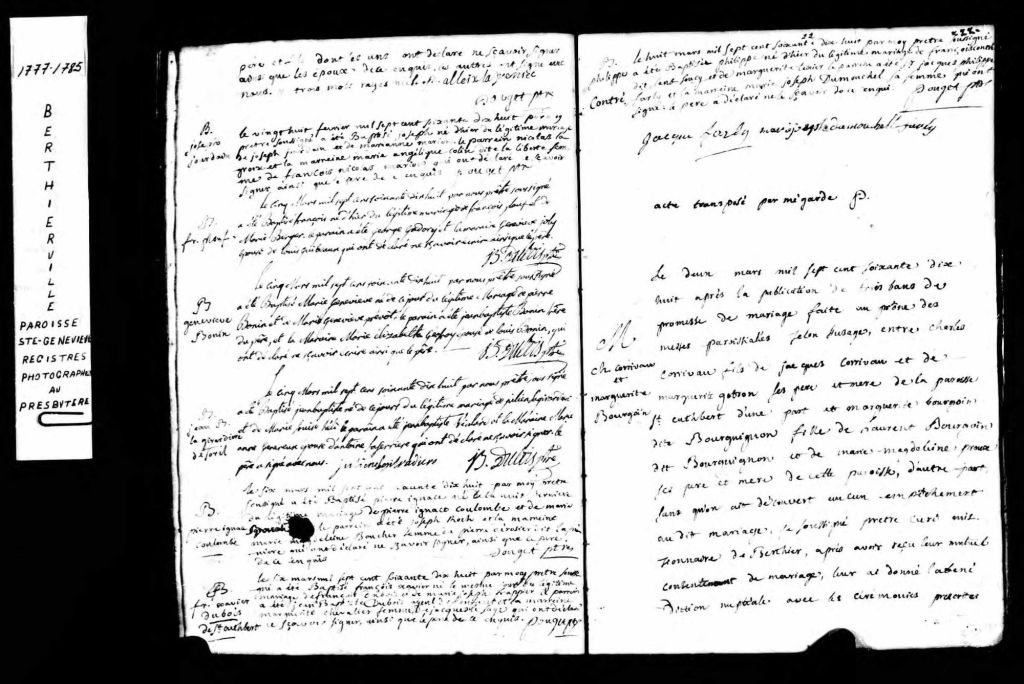
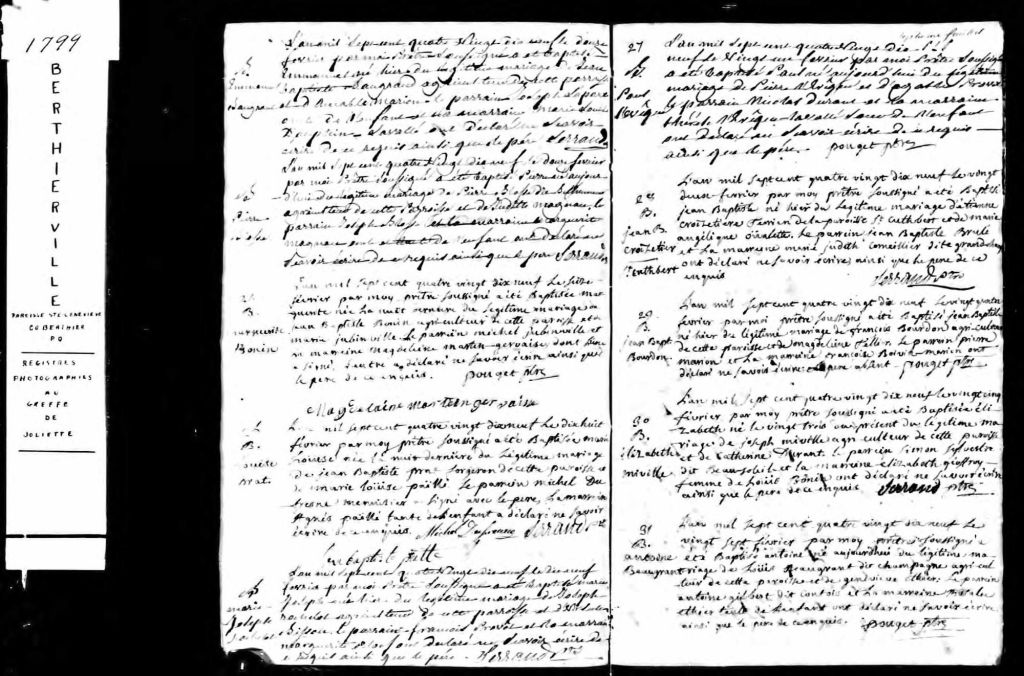
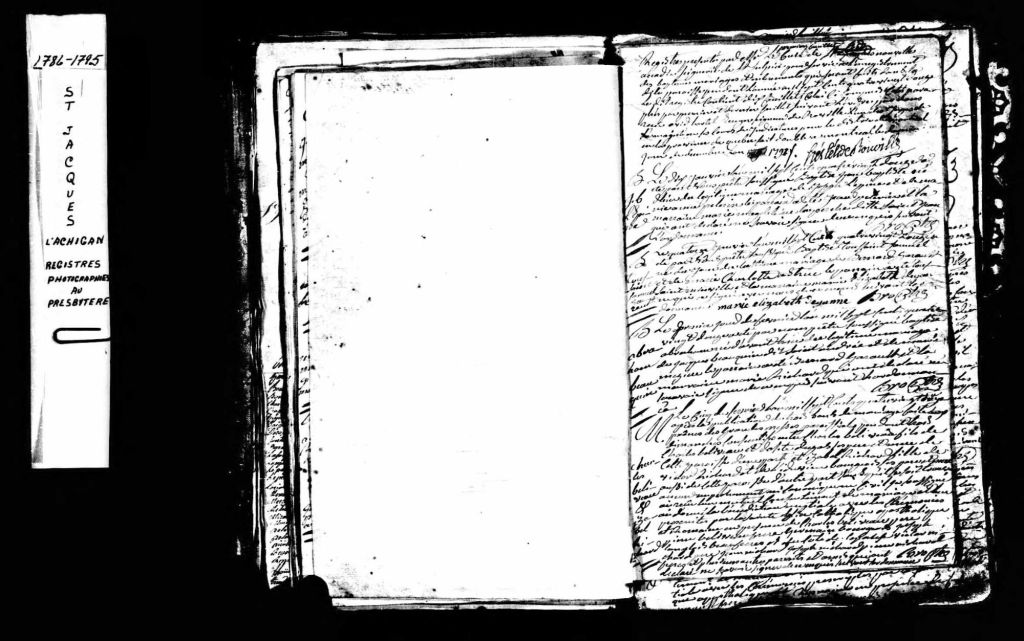
Many descendants of Metabenutin Uininis today identify as Magoua or Métis, following Nicholas Montour’s example. In fact, Nicholas Montour’s son, also named Nicolas, was christened in the nearby parish of Sainte-Geneviève de Berthier, under the surname of Mitif:

NICOLAS MITIF
On the third of October, seventeen eighty-four, by me, the undersigned priest, was baptized NICOLAS, born in Pays d’en Haut of CANADIAN father and SAUVAGESSE mother belonging to NICOLAS MONTOUR residing in the said Pays d’en Haut, already three years old and presented by Joseph FAGNAN. The godfather was Antoine DESROSIERS, and the godmother Elizabeth PAGÉ who, with the presenter, declared that they did not know how to sign.

The descendants of Nicolas Montour, son, continued in the fur trade and later established themselves out West along with many of descendants of the Algonquin Nation, where they are today members of the many Métis communities in Ontario, Manitoba, Saskatchewan and Alberta.

Further reading:

The Montour Family of Red river https://www.metismuseum.ca › …PDF

C’est qui papa, les Sauvages? Rémi Savard https://www.erudit.org/fr/revues/raq/2010-v40-n1-2-raq5005322/1007503ar/

La mémoire orale contemporaine des Metabenutins Uininis (Algonquins de Trois-Rivières) Denys Delâge et Claude Hubert https://www.erudit.org/en/journals/raq/1900-v1-n1-raq5005322/1007500ar/

University of Quebec
https://oraprdnt.uqtr.uquebec.ca › …PDF
D’AUTREFOIS

Histoire de Trois-Rivières https://www.v3r.net/culture/histoire-et-patrimoine/histoire-de-trois-rivieres

Magouas et fiers de l’être, René Hardy: https://gazettemauricie.com/magouas-et-fiers-de-letre-2/

ResearchGate
https://www.researchgate.net › 2425…
(PDF) Les créolismes syntaxiques du français magoua parlé aux Trois …

Métis? Algonquins sans statut? L’évolution de l’identité légale

En 1982, les Métis furent reconnus par la section 35 de la constitution canadienne, à même titre que les Premières Nations et les Inuit. Cependant, aucune définition de ce qu’est un Métis fût incluse, ce qui mènera à devoir se fier au juridico-légal afin d’essayer d’élucider une définition sur l’identité métisse.

Dans notre petite communauté ayant pris naissance près de la rivière du Chicot, on se dit Métis. Nos premiers ancêtres fûrent rassemblés par les Jésuites aux Trois-Rivières. De prédominance de la Nation Anicinaabe – que les Jésuites nommèrent Algonquins, nos ancêtres avaient été attirés par l’éducation et la sécurité des remparts que les Français avaient érigés autour du village.

Le Gouverneur Charles Huault de Montmagny, appelé Onontio avait cédé, à l’usage des Algonquins, un terrain d’un front de quatre perches et d’une profondeur de huit, voisin de celui des Jésuites où devait être bâtie l’église. Le Gouverneur Louis d’Ailleboust de Coulonge l’a agrandi et la terre a été appelée le fief de Pachirini. Cependant, après le décès de Pachirini, le Gouverneur Louis-Hector de Callière arracha le fief à la Nation Anicinaabe, et Seigneurie de Sillery à la Nation des Wendats, pour les remettre aux Jésuites. Ce contrat, signé en 1699, fût exécuté sans le consentement ni en la présence d’aucun représentant des Anicinaabe ni des Wendats.

Mais où étaient partis les Anicinaabe?

En 1701, à peine 2 ans après la perte du fief de Pachirini, Antoine de la Mothe Cadillac employa les descendants du fief afin de faciliter la création du poste de traite au Fort Pontchartrain, maintenant nommée Detroit.

En consultant les registres de naissance ainsi que le registre des contrats de diverses compagnies de la traite des fourrures, on comprend rapidement que les descendants de Anicinaabes des Trois-Rivières avaient été engagés comme Voyageurs. Les Français avaient profité de l’éducation donnée aux Anicinaabe ainsi que leurs contacts familiaux afin de faire l’expansion des routes de traite.

Quelques décennies plus tard, des 1727 Pierre Gaultier de Varennes et de la Vérendrye employa les descendants des descendants des Anicinaabe afin d’implanter un important réseau de forts et de postes de traite, notamment au Manitoba, et noue des relations diplomatiques avec de multiples Premières Nations.

Peu de temps plus tard, nous constatons le retour de ces Voyageurs, accompagnés de leurs épouses et d’enfants. On peut voir aux registres de notre communauté des baptêmes d’enfants, nés de pères chrétiens et de mères de diverses Premières Nations tout au long des forts et postes de traite. Ces enfants sont baptisés avec comme seul surnom: Mitif et Mitive.

Nos ancêtres Anicinaabek et Wendats, se promenaient de poste en poste. Le succès économique des riches marchands de fourrure est grâce aux liens familiaux de nos ancêtres, tissés par unions et naissances et répandus d’un poste de traite à un autre au gré des Compagnies des Cent-Associés, du Nord-Ouest et de la Baie d’Hudson.

Après la tombée de la demande européenne des fourrures pendant prèsde 10 générations, nous avons perdu l’emploi que nous avions entrepris, forçant plusieurs familles à abandonner leur existence semi-nomade. Cependant, un retour sur les terres ancestrales n’était pas évident et se coïncide avec les changements apportés par les Brittaniques: fin du régime seigneurial, municipalisation des paroisses, vente de lopins de propriété avec conditions agricoles.

Nous étions cependant débrouillards; des compagnies avaient commencé l’exploitation forestière afin de combler le besoin grandissant de maisons et d’édifices pour accueillir les immigrants venant du Royaume Uni. Dès le milieu du 19e siècle, nous sommes devenus des “Shantymen”, terme en langue Anglaise désignant les hommes de chantier en Hiver.

Dès 1858, s’ajoute une nouvelle vocation: Guides de chasse. Le gouvernement fédéral avait adopté une loi accordant des droits de pêche qui pouvaient être loués par le ministre pour une période de neuf ans, créant des clubs privés appartenant à des riches Américains. En 1899, les clubs privés sont au nombre de 30, en 1914, de 70 et en 1941, de 614. En 1965, il existe plus de 2000 clubs privés au Québec employant Métis et Premières Nations jusqu’au déclubage en 1977.

Nos ancêtres s’étaient bâti des camps sur ces territoires non-organisés durant cette période, que ce soit pour bûcher ou en tant que guide. Ces camps étaient des abris faits en bois ronds, isolés avec de l’étoupe confectionnée à partir de crinière de cheval, mousse et bouette. C’est certain qu’on passe du temps à récolter pour nos familles et on a tous des lignes de trappe pour combler nos fins de mois. On nous laissait faire, parce que le gouvernement et les entreprises avaient besoin de nous…

Après le déclubage, la gestion de territoires fauniques fût confiée à des organismes à but non lucratif supposément pour rendre la forêt accessible à tous. C’est à partir de ce moment que les zecs (zones d’exploitation contrôlées) ont vu le jour.

À ce moment, les choses commencent à se compliquer. Tous les chasseurs et les pêcheurs doivent déclarer leurs prises; les lignes de trappes sont distribuées sous bail de droits exclusifs de piégeage. Le tout est géré par des organismes gouvernementaux. Aucune Première Nation, ni aucune communauté Métis sont consultés.

Cette époque coïncide avec l’avènement d’organisations luttant pour les Métis et les Premières Nations sans statut. Une des première inquiétudes était justement la perte de notre de nos moyens de subsistance. Nos relations avec les Premières Nations inscrits sous la loi des Indiens depuis 1869 étaient jusqu’à présent basées sur la réciprocité. Nous entrions sur leur territoire sans faire aucunes reclamations.

Dans ma famille, on se dit Métis. Jeune, mon grand-père me disait que c’était comment on faisait la différenciation entre notre vécu nomade et la sédentarisation forcée des Premières Nations avoisinantes. Nous avons développé des traditions et une culture très différente, ayant adopté certaines coutumes puisées de toutes les Nations – incluant les Français et Écossais – dont nous sommes issus.

Mais aujourd’hui, le juricico-légal canadien, établi par des douzaines de causes en Cour, dicte qu’une Nation ou une communauté autochtone se doit d’avoir un lieu géographique déterminant et déterminé par l’autorité gouvernementale canadienne et/ou provinciale.

Ça nous laisse où, nous?

Faudrait-il qu’on revendique le territoire de nos ancêtres Anicinaabeg? Il me semble que c’est vers cette direction que la jurisprudence nous mène.

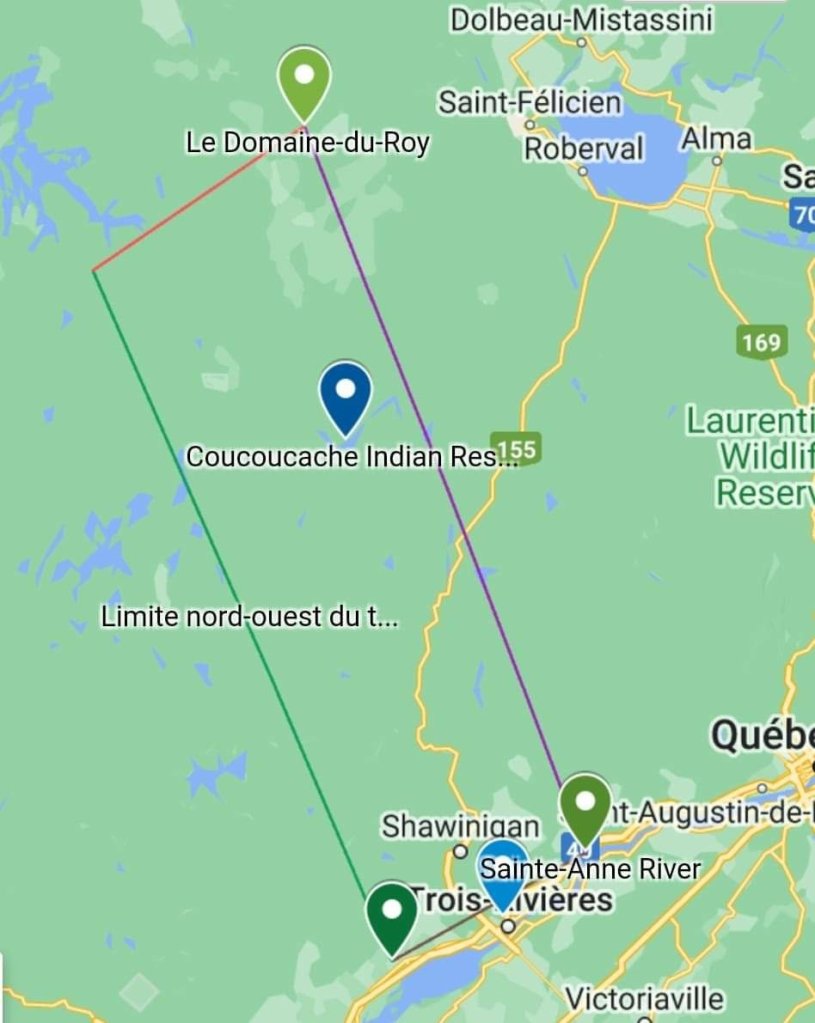
En effet, nos ancêtres avaient négociés avec les Nations avoisinantes selon ces correspondences de 1829, montrant la Nation des Algonquins de Trois-Rivières revendiquer le territoire:

  • à l’ouest de la rivière Ste-Anne-Lapérade,
  • à l’est de la rivière et lac Maskinongé,
  • au nord du Saint-Laurent en passant par Coucoucache jusqu’au limites de La Tuque et Poste du Roi appartenant à la Nation Atikamekw.
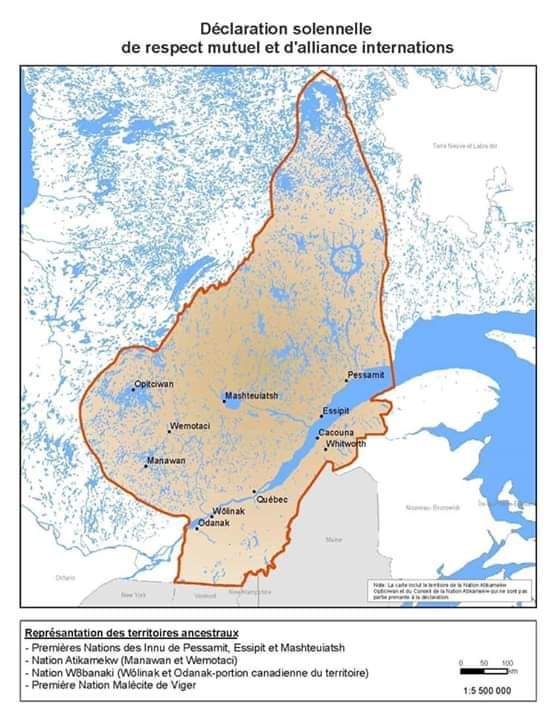
Approximation du territoire revendiqué pas la Nation des Algonquins

Voici le sommaire de la rencontre entre les Chefs des Nations des Algonquins, Abénakis et Wendat donnant raison sur la délimitation territoriale de la Nation des Algonquins de Trois-Rivières. Les documents originaux sont en ma possession:

Lettre: signalant que les Algonquins de Trois-Rivières revendiquent la moitié sud-ouest de la rivière Sainte-Anne Laperade comme limite est et Masquinongé comme limite ouest. Le Saint-Laurent au sud et la profondeur d’une cinquantaine de lieues au nord, en remontant la rivière Saint-Maurice jusqu’au lieu-dit Cococachechinque où ils rejoignent les Postes des Rois/La Tuque/limites des terrains de chasse appartenant aux Têtes de Boules.
Lettre avisant que les Abénakis prétendent avoir des droits égaux pour chasser sur les terres non concédées de la rive nord du fleuve Saint-Laurent entre la rive sud-ouest de la rivière Sainte-Anne La Perade et le lac Masquinongé, et s’étendant sur une cinquantaine de lieues en amont la rivière Saint-Maurice jusqu’au lieu-dit Cacocachichinque; mais les Algonquins revendiquent des droits exclusifs sur ces terres. Déclare que la déclaration de M. Nivervilles est défavorable à la revendication faite par la tribu des Abénakis.
Lettre: ajoutant un commentaire (concernant une autre lettre, même date) à l’effet qu’il ne semble pas que l’une ou l’autre des tribus (abénakis ou algonquins) ait des droits sur les terrains de chasse qu’elles décrivent et que ce serait un mauvais précédent pour le gouvernement de reconnaître les revendications de l’une ou l’autre tribu.
Lettre avisant qu’un conseil a été tenu à Trois-Rivières le 26 (août) au sujet des difficultés dans les revendications de terrains de chasse. Précise que les Hurons de Lorette, les Algonquins de Trois-Rivières et les Chefs Abénakis de Bécancour et Saint-François étaient présents. Avertit qu’il ressort de l’enquête que les Algonquins avaient raison quant à leur affirmation selon laquelle les terres au nord du Saint-Laurent leur appartenaient et que les Abénakis possédaient le côté sud. Déclare que la situation est difficile car il reste peu de terres à chasser pour les Abénakis du côté sud mais ils ont des terres et des rentes seigneuriales mais les Algonquins n’ont d’autre recours que la chasse. Déclare que le chef algonquin souhaite que la décision de droit soit prise par un conseil des Six Nations ou par Son Excellence mais que les Abénakis souhaitent qu’elle soit prise par Son Excellence seule. Avise que les difficultés entre les Hurons de Lorette et les Algonquins de Trois-Rivières ont été réglées par arrangement écrit qu’il joint..

À quel point étions-nous plutôt Métis que Algonquins? À quel moment pouvons-nous determiner l’ethnogénèse de notre Peuple, fondé par nos ancêtres engagés comme Voyageurs qui ont développé une culture et des traditions distinctes, imprégnées par les rencontres avec diverses Premières Nations avec qui nous vivions temporairement. Nos ancêtres ont marié des femmes de ces Nations et se sont marié entre eux et nous avons été élevés dans un mélange de cultures et traditions tout en créant culture et traditions propres à nous et différentes des québécois et immigrants.

Mais est-ce équitable? Devons-nous nous plier à la jurisprudence? Devons-nous nous résoudre à accepter avoir été absorbés par les Blancs et accepter aussi que notre Histoire soit effacée? Devons-nous nous plier à l’appropriation de ce que nous sommes – Métis – car ce mot descriptif se veut désormais exclusif à ceux des autres provinces?

Une chronologie sur le Blanchiment de l’identité autochtone et l’extinction des Droits intrinsèques

Malgré l’établissement colonisux européens depuis 1534, 229 ans se sont écoulées sans législation de l’identité autochtone.

Nous avons tendance à nous référer à la loi constitutionnelle de 1867 comme étant la principale loi qui aura permi au gouvernement d’imposer le statut d’Indien, de gérer les terres des réserves et les fonds communautaires.

Mais l’intention de mettre fin aux droits des Peuples autochtones aura débuté 104 ans avant la Loi sur les Indiens.

Voici la chronologie:

1763: La proclamation royale. Proclamée «Magna Carta indienne». Elle garantissait certains droits et protections et établissait comment la Grande-Bretagne pouvait acquérir des terres.

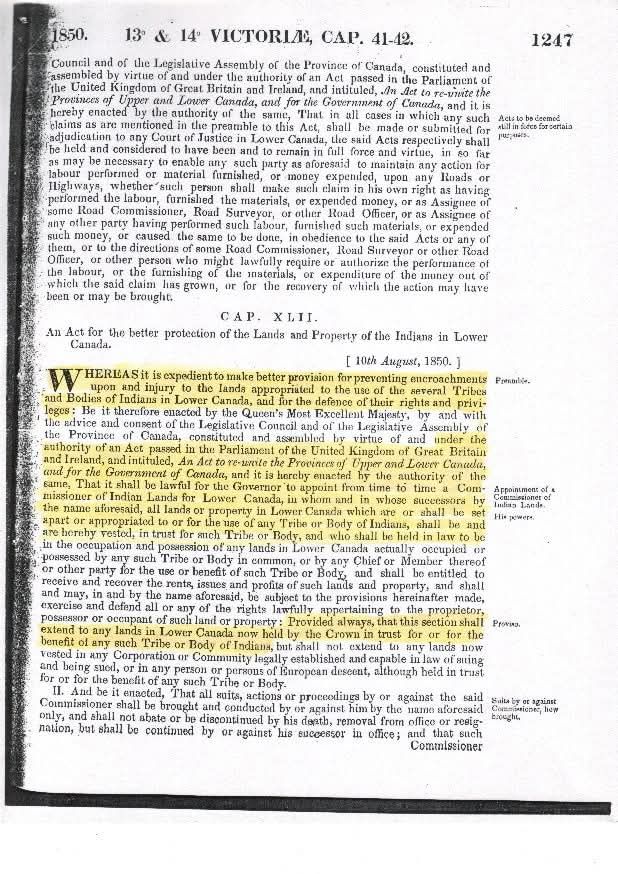
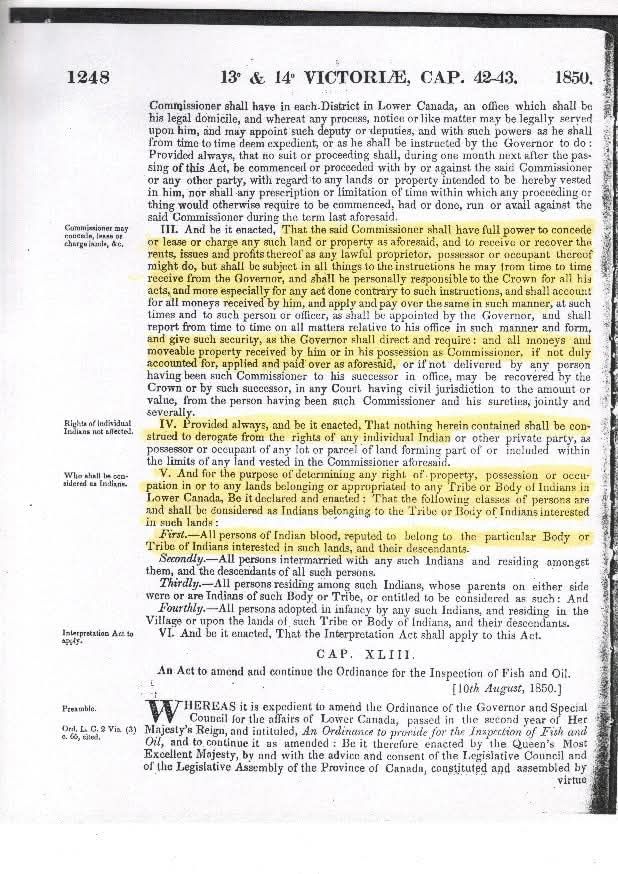
1850: Loi pour une meilleure protection des terres et des biens des Indiens du Bas-Canada. Sont inclus tous les descendants de ces personnes, les non-Indiens qui «se sont mariés avec de tels Indiens», les personnes dont les parents étaient considérés comme des Indiens et «toutes les personnes adoptées par eux»

1857: La cinquième législature de la province du Canada adopte l’Acte pour encourager la civilisation graduelle des tribus sauvages en cette Province. Tout Indien qui sait lire ou parler anglais ou français, n’a aucune dette et qui est de bonne moralité, est considéré comme une «personne morale» et «civilisé» aux yeux du gouvernement britannique.

1869: l’Acte pourvoyant à l’émancipation graduelle des Sauvages. Cette définition plus restreinte de qui était considéré comme un Indien. Seules les personnes d’un quart de sang indien pouvaient être reconnues indiennes.

1870: Loi sur le Manitoba. Les particuliers résidant à proximité de la ville de Winnipeg actuelle se sont vus offrir Scrip, un billet à ordre donnant à chacun une propriété privée de 64 hectares en échange de leur titre foncier indien.

1876: Loi sur les Indiens. Destinée à consolider toutes les ordonnances précédentes visant à mettre fin à la culture des Premières Nations en faveur de l’assimilation à la société euro-canadienne. Une grande partie de la loi relative à l’identité et aux exclusions fondées sur le sexe a depuis été abrogée et la loi a fait l’objet de plusieurs modifications.

Tous les descendants des personnes qui ont été exclues par l’une de ces lois restent victimes d’injustices historiques du fait de leur colonisation. Nous sommes notamment empêchés d’exercer nos droits au développement conformément à nos propres besoins et intérêts, et notre droit à l’autodétermination est refusé.

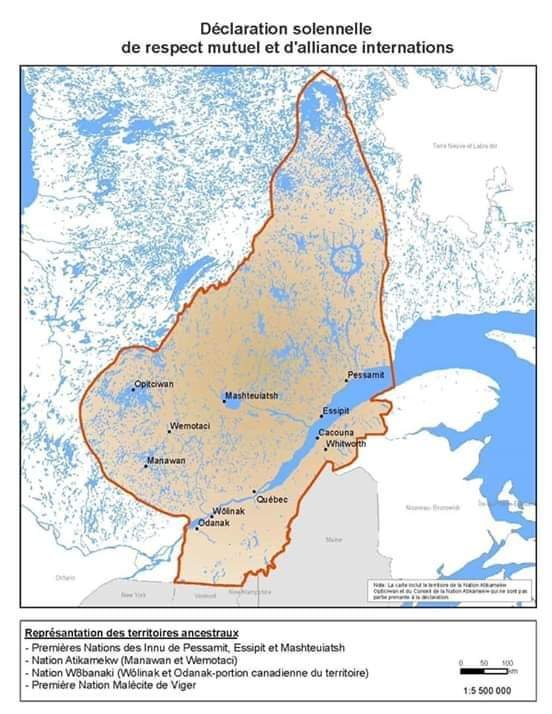
Nouveau conflit territorial entre Premieres Nation au Québec: mon opinion personelle en tant que Métis

Ici au Québec, les gouvernements fédéral et provinciaux ont à nouveau réussi à s’impliquer dans la gouvernance territoriale des peuples autochtones et ont réussi à se diviser pour conquérir.

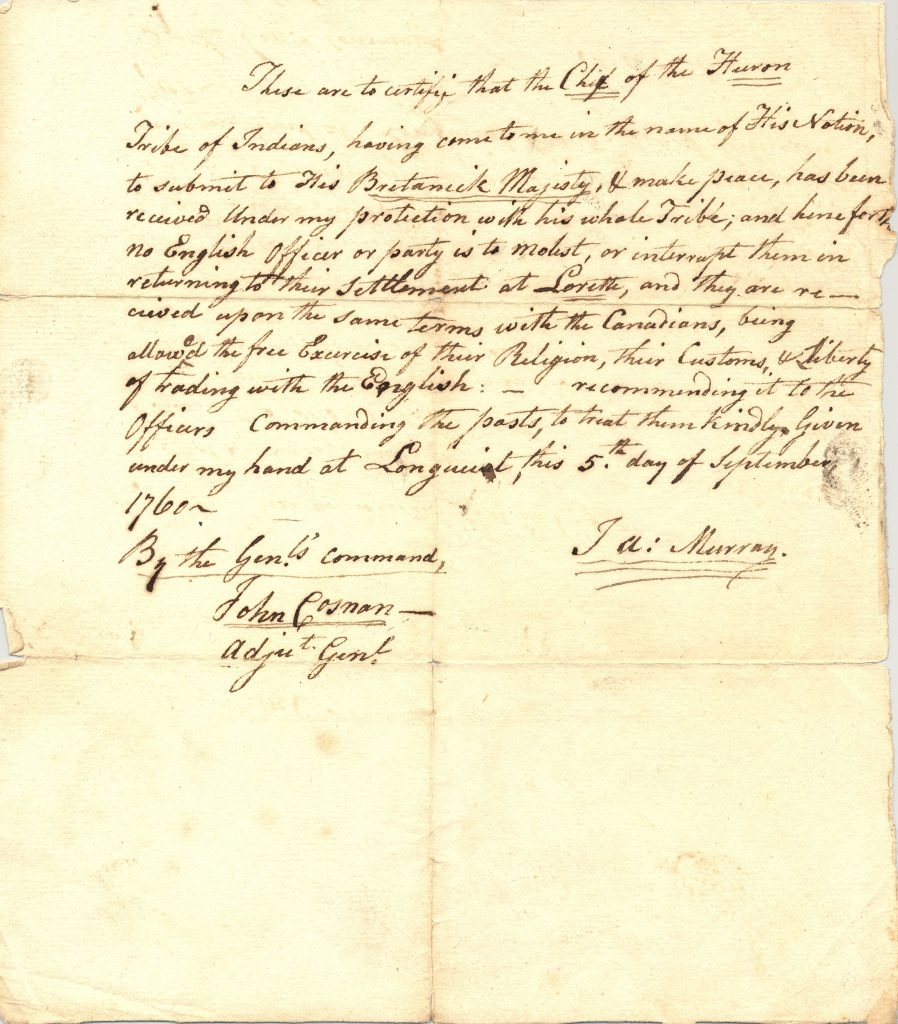
Le gouvernement a transformé un traité de paix et d’amitié de 1760 entre la nation Wendat et les Britanniques en un conflit foncier territorial.
Voici le document en question:

“Ceci certifie que le chef de la tribu des Indiens Hurons, venu à moi au nom de sa nation, pour se soumettre à sa majesté britannique afin de faire la paix, a été reçu sous ma protection avec toute sa tribu; et aucun officier ou parti anglais ne doit les molester ou les interrompre en revenant à Lorette, et ils sont reçus dans les mêmes conditions, avec les Canadiens, être autorisés à faire librement de leur religion, de leurs coutumes avec la liberté de commercer avec les Anglais – recommandant aux officiers commandant les postes de les traiter avec bonté sous ma main à Longueuil, ce 5 septembre 1760.
Par ordre du général, John Cosman, adjut. Genr.

Je ne peux même pas imaginer les pertes en vies humaines et la terreur que la nation Wendat avait traversée pour parvenir à ce point de soumission, après plus d’un siècle de protection des Français.

Depuis des temps immémoriaux, bien avant l’arrivée des colons européens, les Premières nations Innu, Maliseet, Abenaki et Atikamekw ont vécu de façon continue sur le territoire de leurs ancêtres.

Historiquement, en ce qui concerne les zones de chevauchement, ils ont toujours été en mesure de partager et de gérer l’utilisation des terres de manière harmonieuse. Il appartient aux peuples autochtones de décider ce que nous voulons ou ne voulons pas sur leurs territoires.

En tant que peuple de contact post-européen, les Métis qui partagent les territoires doivent respecter le fait que les Premières Nations sont les premiers intendants de la terre et que nous devons suivre leurs conseils sur ces questions.

La population autochtone du Québec ne représente que 2,29% (1,43% si l’on exclut les Métis de la population autochtone totale); déjà moins de la moitié de la moyenne canadienne de 4,87% – (2016).

Nous séparer en groupes encore plus petits et distincts facilite leurs objectifs de division qui régissent depuis longtemps.

Pire encore: ils nous obligent à nous battre pour chaque morceau de terre nécessaire à la continuité de nos traditions. C’est l’enfer.

Nous sommes plus forts quand nous sommes unis.

Volume II: A brief story of Élisabeth Couc, who became known as Isabelle Montour.

Translated from an article entitled “De remarquables oubliés – Isabelle Montour“, published by Radio-Canada in November 22, 2016.

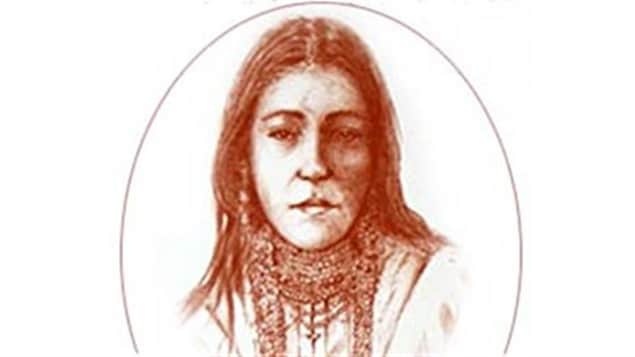
A woman of rare intelligence and great beauty, Isabelle Montour is a prominent figure in the young history of the United States.

Élisabeth Couc was born in 1667 at the fiefdom of Algonquin Sachem Pachirini in Trois-Rivières. Her mother Marie Mite8ameg8k8e is Algonquin. Her father, Pierre Couc, from Cognac, is one of the first settlers.

In 1676, the family moved to Saint-François, on the other side of the river from Trois-Rivières. In 1679, Jeanne, the eldest child, was raped and killed by a man called Rattier, an employee of Lord Jean Crevier.

This tragedy illustrates the Settler’s disregard for the Métis. Elizabeth is 12 years old and she will never forget the incident.

From Couc to Montour

It is Elizabeth’s brother, Louis, who adopts the name of Montour when baptizing his children. In 1687, Elizabeth became Isabelle and she married Joachim Germaneau, a much older coureur des bois. Her sisters also marry coureurs des bois. The men know each other and do business together.

A desired woman

In 1692, Isabelle Germaneau and her two sisters moved to the Michillimackinac area, the strategic post between Lake Huron and Lake Erie, then ruled by Lamothe-Cadillac. In 1693, Isabelle’s husband disappears in the woods: she is widowed at 26 years old. Isabelle is very beautiful and leads a libertine life. Lamothe-Cadillac had her arrested and returned to Quebec.

A sparkle

In Quebec, Isabelle Montour is kidnapped by an Indian chief Ottawa, Outoutagan, a very handsome man, who brings her back to Michilimackinac. They marry. It is from this moment, in 1697, that Isabelle becomes an interpreter: she speaks Algonquin, Huron and Iroquois, which is unique. Around 1701, she separated and married a French soldier: she became La Téchenet and moved to Detroit.

The beginning of a saga

Étienne de Maubourg, who came from France to inspect the Cadillac colony, becomes Isabelle’s new lover, who is nearly 40 years old. Meanwhile, Louis Montour fur trade with the English who want to break to the west. He is very powerful. In Detroit, many people desert to follow him, including Isabelle and Etienne.

Maubourg had an affair with a married woman, Madame Tichenet, known as “La Chenette”, at Fort Pontchartrain. After his desertion in 1706, the couple met up and lived among a group of deserters on an island in Lake Erie

The French go after them. They do not find them, but their heads are priced.

In 1709, Louis Montour was murdered by Private Joncaire on the orders of Governor Vaudreuil.

A clan mother

Isabelle takes over from her brother. After having entrusted her daughter to her sisters in Trois-Rivières, she returned to Albany. She moved to Iroquois territory. She becomes accepted by the Oneida Nation and definitively adopts the name of Montour. She marries the chief Karontowa:nen, known also as Robert Hunter, of whom she is very in love. She is a diplomat who participates in all major conferences. Despised by the French, she is greatly respected by the English. She perpetuates the legend of her brother Louis.

Descendants of Marie Mite8ameg8k8e (click to enlarge)

A big liar

During her old age, her son Andrew manages to get her a big stone house. She receives a lot and likes to tell her life, but by inventing all sorts of stories! That’s why there are passages that remain unknown in this unusual life. Isabelle Montour died in 1751, at the age of 85.

She left a large Métis descent named Montour.

At the beginning of the story

In 1670, the population of New France was barely 6,700 people against 120,000 in New England. The Hudson’s Bay Company has just been created under the influence of Médard Chouart des Groseilliers and Pierre-Esprit Radisson. In 1676, the defeat of the Indians in New England gave European settlers control of the North American coast.

Epilogue

In 1850, in Pennsylvania, in memory of Madame Montour and her descendants, Montour County was created in the Susquehanna Valley named in honor of Madame Montour. In the United States, there are, in New York State, the Montour Falls and the city of Montour.

Meanwhile

In 1679: Cavelier de la Salle explores the Great Lakes region. Then he goes down the Mississippi River. He takes possession of Louisiana in the name of France.
In 1863: William Penn signs a peace treaty with the Delaware Indians.
In 1686: Pennsylvania attracts many German and French Protestants who chose exile after the revocation of the Edict of Nantes.
In 1691: a far cry from virginia condemns to banishment any individual who is married to a black man, a mulatto or an Indian.
In 1699: the first permanent French colony is established in Louisiana.

References and bibliography:

Madame Montour and her time, by Simone Vincens, published by Hébert publications.

Mrs. Montour, White Queen of the Iroquois, by George G. Struble, published at Lebanon Valley College.

Volume I: Pachirini, Mite8meg8kwe, Couc, Lafleur and their offspring

Pachirini, an Algonquin appears as a young warrior wounded who was cared for by Jeanne Mance at the Hôtel-Dieu in Montréal in March of 1643.
He was baptized on April 2, 1643 in Montréal by Father Imbert Duperon. He was given the Christian name of Charles. One of the witnesses was Jeanne Mance.
His fellow tribesmen left for Trois-Rivières. Charles lived here for some time with the two Jesuits of the post and led them to explore the shore that was later to become Laprairie (a Jesuit mission). He rejoined his people at Trois-Rivières and, prior to 1648, became the captain of the Christian Algonquins, even during the life-time of TESSOUEHAT.
Sachem Pachirini was Chief of the Weskarini Band of the Algonkin Tribe. He was given a Fiefdom in Trois-Rivières. Governeur-general Montmagny had actually given him, for the use of the Algonquins, a plot with a frontage of four perches and a depth of eight, next to that of the Jesuits where the church was to be built. Governeur-general D’Ailleboust enlarged it and the land was called Pachirini’s fief, which is now the Place d’Armes.
Weskarini was an Algonquian tribe that lived on the north side of Ottawa river below Allumettes Island (Morrisson’s Island), Québec, with the people of which they appear to be closely associated in the Jesuit Relations.
They were known as Petite Nation des Algonquins, Little Nation of the Algonkin.”
The Weskarini Peoplealso known Algonkin Proper, La Petite Nation, Little Nation, Ouaouechkairini, Ouassouarini, Ouescharini, Ouionontateronon (Huron word), Petite Nation were originally localed on the north side of the Ottawa River along the Lièvre and the Rouge Rivers in Québec.
Known variously as: Algoumequins de l’Isle, Allumette, Big River People, Gens de l’Isle, Honkeronon (Huron word), Island Algonkin, Island Indians, Island Nation, Kichesippiriniwek, Nation de l’Isle, Nation of the Isle, and Savages de l’Isle. Main village was on Morrison’s (Allumette) Island.”
It appears from PRDH documents that Pachirini had two wives. In any case, he fathered several children with two Algonquin women: Marie 8KI8TIABAN8K8E (Oukioutiabanoukoue – French spelling) and SEHAM8 (Sehamou).
One of my ancestors, Marie Mite8meg8kwe, aka MITOUAMEGOUKOUE (French spelling (pronounced: mee-tee-wa-mee-gou-kwee) was born around 1631-1632 in the “Nations des Ouionontateronon”(Huron word for Weskarini Band of the Algonkin Tribe), in the area between the Ottawa and the St-Maurice rivers in Québec.
She was baptized on November 6th, 1650 in Montréal.
Latin transcription Anno D[omini] 1650 ego ide[m] baptizavi Mariam Mite8ameg8k8e nunc Kakesik8k8e dictam uxore[m] Asababich. Matrina fuit Maria uxor Lepine. 6 Novemb[ris] Traduction française En l’an du Seigneur 1650, moi, le même (Claude Pijart de la Société de Jésus, desservant de cette paroisse), j’ai baptisé Marie Mite8ameg8k8e maintenant dite Kakesik8k8e, épouse d’Asababich. La marraine fut Marie, épouse de Lepine. (Fait) le 6 novembre. English Translation “In the year of Our Lord 1650, I, the same [Claude Pijart of the Society of Jesus], have baptized Marie Mite8ameg8k8e, now named Kakesik8k8e, the wife of Asababich. The godmother was Marie, wife of Lepine. [Executed] the 6 of November.
She, along with other members of the Weskarini tribe, lived in the Fiefdom Pachirini (today called Place d’Armes), in Trois-Rivieres.
Marie caught the eye of the soldier-farmer, Pierre Couc dit Lafleur, who had purchased land and had established a farm in Trois-Rivieres.
Pierre had learned the Algonquin language and frequently served as an interpreter between the colonists and the Native Americans. Marie Mite8ameg8kwe had taken an interest and enjoyed his frequent visits to her village.
Pierre was 30 years old; Marie was an orphan and a widow who had lost two children. They married five winters (16 April 1657) after her family had been taken from her by the Agniers (Mohawks). The Jesuit priest, Father Paul Ragueneau officiated at this Christian-Algonquin marriage.
Their 1st child, Jeanne was born and baptized that year (1657). Pierre had purchased land from the Trottier brothers, enough to build a house and a small garden. He hired himself our as a laborer for Barthelemy Bertaux, ironsmith. Pierre and Marie had problems during those first years. Loans were reclaimed. Pierre injured himself and had enormous medical costs. He lost his employment as an ironsmith.
Two years after their marriage (15 Oct 1659), Pierre commissioned his friend Notary Severin Ameau to draw up a Marriage Contract to insure that his wife and children would be rightful heirs to his property.
That same year, Marie was pregnant with their 2nd child. Their son was born in the fall of the year and baptized as Louis.
The Agniers began their attacks once more. Pierre decided, two years later (1661) to move his family to Cap-de-la Madeleine where he had bought 4 arpents (acres) of land on the west bank of the river. This was an agricultural community where crops grew well and family life was better than at a trading post like Trois-Rivieres. Pierre built his house near the windmill and erected a palisade around it.
Marie Angelique, 3rd child of Pierre and Marie was born the year after the Couc family had moved to their new community (1662).
Two years later (1664), the 3rd daughter, Marguerite was born and baptized.
The quiet peace was again disturbed by Agniers raids. Over the next 5 years, the new governor convinced France to send soldiers, the Carignan Regiment, to finally quell the Iroquois attacks. Finally, a peace treaty was signed in the summer (1667) For the next 16 years, it was an era of calm and prosperity for everyone.
Elizabeth, the 5th child, was born and baptized that summer of the peace treaty, when the Iroquois finally renounced their domination of the Saint Lawrence valley.
Marie continued instructing her brood in the Algonquian language and culture; Pierre taught his children French and his heritage; and the Jesuits taught the children to read and write.
Over the next 6 years, two more children were born in the Couc family: Marie Madeleine and a son, Jean Baptiste.
During this time, the atmosphere in Cap-de-la Madeleine had begun to change dramatically. With the departure of the Jesuits in 1666, the Cap became contaminated by the illegal traffic of alcohol. On 10 Nov 1668, the sovereign Council granted permission for the legal sale of alcohol, even to the Natives.
The change in atmosphere undoubtedly prompted Pierre and Marie to move their family to the seigniory of Jean Crevier, in the Ile-de-Fort, which would eventually be known as St. Francois-du-Lac.
Jean Crevier had begun to distribute land grants in the fall of 1673. Marie must have been very proud of her husband, as one of the first five signers of a contract. Crevier had begun to clear the land, had built a village mill and had established justice for this seigniory. There was a poll tax system where a person paid for a right to farm and obtain 3 to 5 arpents (acres) in frontage by 30 to 40 in depth. The only charge was to leave the fourteenth milling as grinding costs.
There is no doubt that these favorable conditions prompted Pierre and Marie to decide to move their home to the other side of the river. Because of his revenues from land at Trois-Rivieres and Cap-de-la-Madeleine, the former soldier-peasant became a well-to-do land owner at St. Francois-du-Lac.
By the work of his hands during 15 years, Pierre Couc had the right to show justifiable pride in his home and land.
Life at St. Francois-du-Lac was very different than that at Trois-Rivieres and the Cap. The first 3 children had learned to read and write because the Jesuits took charge of teaching the basics. In St Francois there was total isolation. There were only traveling missionaries who came sporadically to administer the sacraments.
Marie Mite8meg8kwe’s quiet life was shattered in the fall of 1679 by the assault and death of her daughter, Jeanne. Marie’s husband had been wounded in coming to the rescue of his daughter. Jeanne’s assailant, Jean Rattier, was sentenced as a murderer. For the Couc family, life was not the same after the tragic loss of their daughter and the lengthy justice process. Pierre was a man of character, he respected the law and expected others to do so also. Justice had been carried out, but not to his satisfaction.
For the Couc family, life was not the same after the tragic loss of their daughter and the lengthy justice process. Pierre was a man of character, he respected the law and expected others to do so also. Justice had been carried out, but not to his satisfaction.
Marie and Pierre continued to see their family grow and become adults with a succession of marriages.
Angelique married Francois Delpee St.Cerny dit Belcourt. He was 35 years old and she was 20 years old. In the summer (30 Aug) 1682, they married and established a home on 12 arpents (acres) of land in St-Francois-du-Lac. They had 5 children.
Louis first married according to the Indigenous culture, a young woman from the Sokoki Nation named Madeleine (1681). This marriage was not recognized by the Catholic Church.
His first son, Francois, was listed as a natural child on baptismal certificate. Louis later married Jeanne Quiquetig8k8e in the winter of 1684.
Marie Madeleine married Maurice Menard dit Fontaine, the son of wheelwright Jacques Menard, They were married before the end of the year 1684.
Elizabeth married Joachim Germanau/Germano in the spring of 1684, at the same time as her brother Louis. She was also known as Isabelle. She was 17 and Joachim, who had arrived in 1665 with the Carignan Regiment, was in his forties. Germano had been a trader with the Indians for pelts, loading them on canoes to transport back to the colony.
During the winter of 1687, the French invaded the Seneca territory (one of the Iroquois Five Nations). A mediocre victory by the French only incited the summer raids of vengeance ravaging the banks of the Saint Lawrence. There was not one single fortified place to resist the enemy. Each seigniory was ordered to build a fort. Crevier received the help of the troops to build his fort. The village of Saint Francois was secure the following winter; the villagers followed their normal life. The summer of 1688, smallpox created havoc; the Mohawks forced themselves into Sorel, Saint Francois and Riviere-du-Loup (Louiseville). there were not many massacres, but the raids were enough to put fear in the inhabitants.
Elizabeth/Isabelle had been given land in Trois-Rivieres and settled there with a generous dowry from her father. Marie never learned to read and write. When she served as a witness to her daughter Isabelle/Elizabeth’s wedding, her mother simply affixed her mark-a totem of a bird to the marriage contract.
Marguerite married three times:
Jean Gauthier dit Delisle, (b. 1632) who died in L’Assomption in 1683, shortly after their marriage
Jean Fafard, (1657- Detroit 1702) Married in the winter of 1688 in Sorel, because there still was not a chapel at St.Francois-du-Lac.
Michel Massé, (1671-1730)
Louis adoped the surname Montour. He had hired himself out to become a beaver hunter. He joined his two brothers-in-law Germano and Fafard who were experts in this field. The three men were on their return home during the following summer of 1689 when the massacre of Lachine, near Montreal spread its terror among the families. In November, St. Francois was attacked; the Iroquois did not attack the fort, but they killed two inhabitants and with flaming arrows burned the newly constrected chapel.
In 1690 Pierre died. Marie and Pierre had been married for 37 years and had combined two cultures into one unique way of life. Pierre Couc, one of the hard working founders of French Canada, in the presence of his family and a large friendly crowd, was buried at the age of 63 years, beneath the ruins of the chapel of St. Francois where he would stay while the rest of his family took refuge in the Trois-Riviere fort.
Jean Baptiste, the youngest child, married an Indigenous woman named Anne around 1705 in Lachine. She was either Algonquin, Sokoki or Abenaki.
Marie Mitew8meg8kwe is remembered in history by a simple Christian record, written by Elisee Crey, Recollet Priest, Pastor of Trois-Rivieres, on her burial certificate as a “Sauvagesse”-“a female Native or Savage.”
The year 1699, the eighth of January was buried in the cemetery of the parish of Notre Dame of Trois-Rivieres Madame Lafleur, native widow of Mister Lafleur after having received all the sacrements in the manner of a true Christian-by my hand, a Recolet priest having carried out the pastoral duties, Father Elisee Crey, Recolet.
Many thanks to Norm Leveillée (www.leveillee.net), Suzanne Boivin Sommerville, Mindy Ruffin for this research.

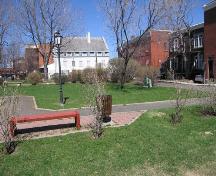
Fief Pachirini: terres volées – stolen lands.

Place d’Armes, aux Trois-Rivières.

Le ministère de la Culture et des Communications du Québec déclare que:

La valeur patrimoniale de la place d’Armes réside dans son intérêt historique. Il reflète le riche passé de la ville de Trois-Rivières et son premier développement urbain. Le fief initial, concédé au chef algonquin Charles Pachirini (Baazhińiniwish) en 1648, est avant tout un campement autochtone. Il est cependant géré par les jésuites qui octroient de petits lots aux colons à partir de 1656 et devient ainsi une demeure française.

En 1722, le terrain est converti en marché public. Devenu une place d’Armes dans la seconde moitié du 18ème siècle, il fut utilisé pour des exercices militaires jusqu’au début du 20ème siècle. Le canon en bronze fabriqué en Russie et découvert en 1828 aurait été rapporté par des soldats de Trois-Rivières ayant participé à la guerre de Crimée (1853-1856). Le site conserve encore le nom de Place d’Armes, bien qu’il soit maintenant utilisé comme parc urbain.

La valeur patrimoniale de la Place d’Armes repose également sur son intérêt pour l’histoire de la conservation du patrimoine au Québec. Contrairement à la “loi sur la conservation des monuments et des œuvres d’art d’intérêt historique et artistique” adoptée en 1922, la “loi sur la conservation des monuments, sites et objets historiques et artistiques”, sanctionnée en 1952, intègre des paysages et des sites de intérêt artistique ou historique dans les biens susceptibles d’être protégés. La place d’Armes, classée en 1960, est le premier lieu protégé au sens de cette loi.

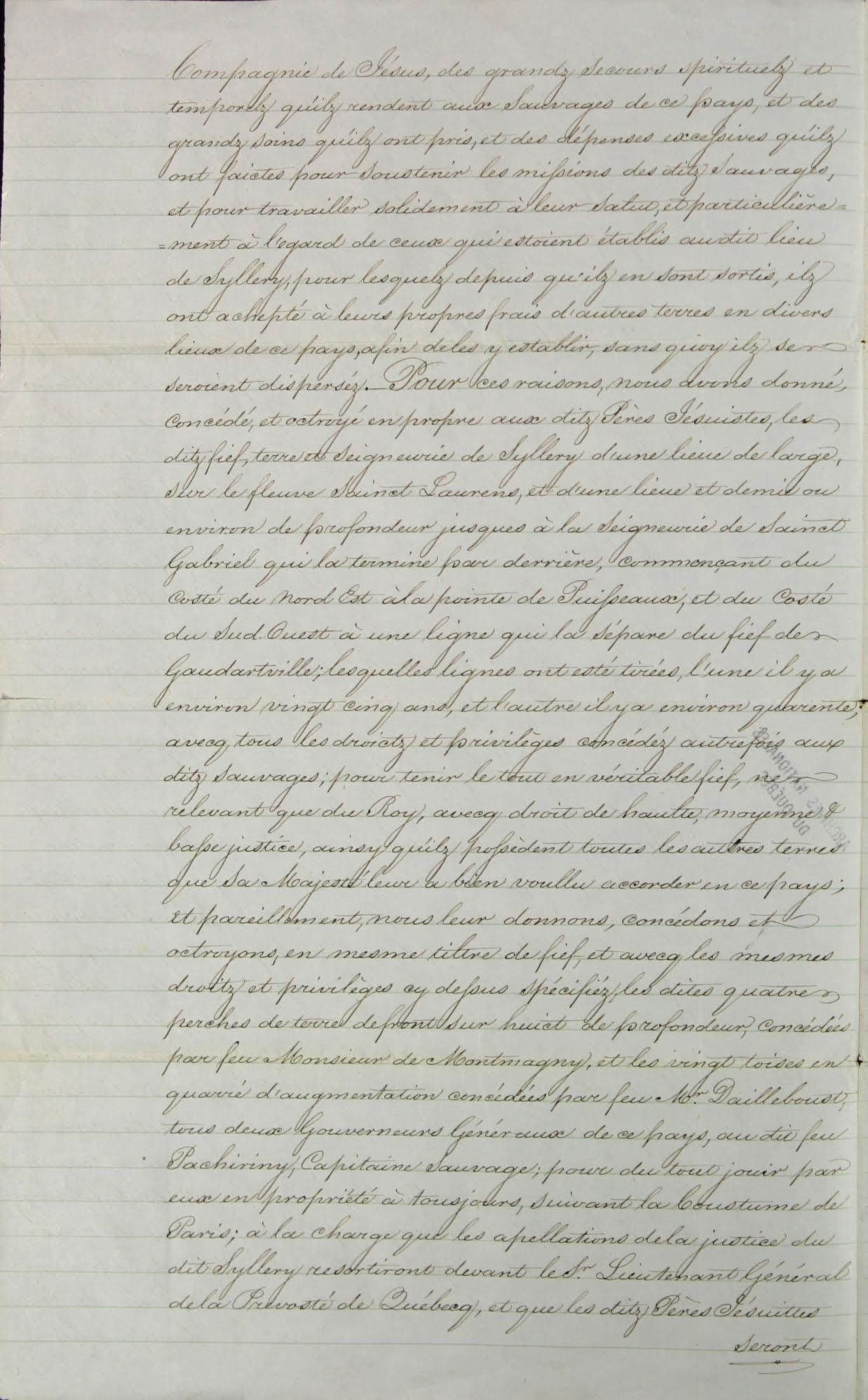
Cependant, dans le contrat de 1699 ci-dessous, nous voyons que la terre a été transférée aux jésuites, sans aucune consultation des peuples autochtones qui avaient occupé la terre:
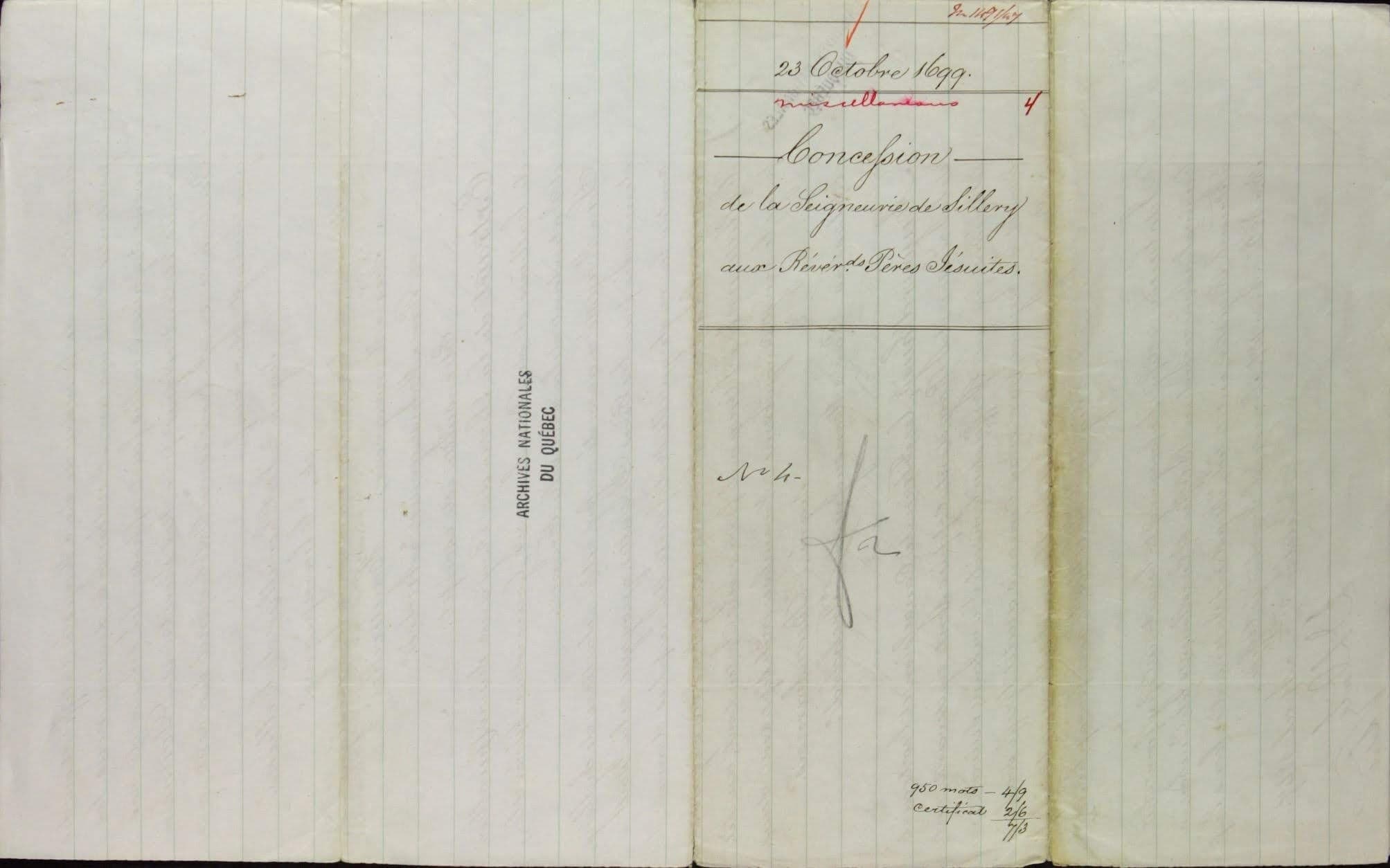
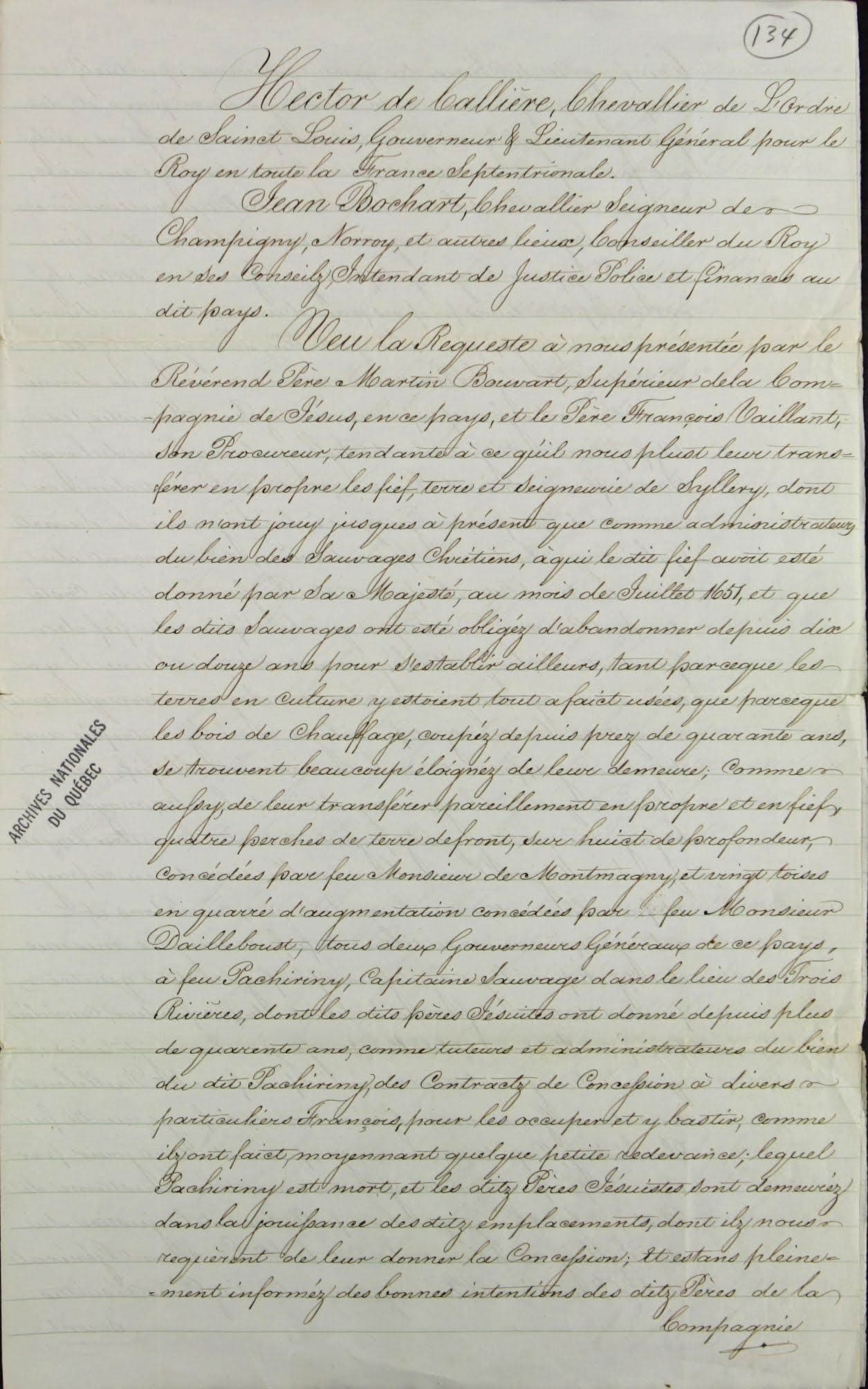
23 Octobre 1699
Concesfsion
De la Seigneurie de Sillery
Aux Révérends Pères Jésuites

HECTOR de CALLIÈRE, Chevallier de L’Ordre de Sainct Louis, Gouverneur & Lieutenant Général pour le Roy en toute France Septentrionale.

JEAN BOCHART, Chevallier Seigneur des Champigny, Norroy et autres lieux, Conseiller du Roy en ses Conseilz, Intendant de Justice Police et Finances au dit pays.

VU LA REQUESTRE à nous présentée par le Révérend Père Martin Bouvart, Supérieur de la Compagnie de Jésus, en ce pays, et le Père François Vaillant, son Procureur, tendante à ce qu’il nous plust leur transférer en propre les fief, terre et Seigneurie de Syllery, donts ils n’on jouy jusques à présent que comme administrateurs du bien des Sauvages Chrétiens, à qui le dit fief avoi testé donné par Sa Majesté, au mois de Juillet 1651, et que les dits Sauvages ont été obligéz d’abandonner depuis dix ou douze ans pour s’establir ailleurs, tant parce que les terres en culture y estoient tout a faict usées, que parceque les bois de chauffage, coupéz depuis prez de quarante ans, se trouvent beaucoup éloignéz de leur demeure, commes au foy, de leur transférer pareillement en propre et en fiefs, quatre perches de terre de front, sur huict de profondeur, concédées par fe Monsieur de Montmagny, et vingt toises en quarré d’augmentation concédées par feu Monsieur Dailleboust, tous deux Gouverneurs Généraux de ce pays, à feu Pachiriny, Capitaine Sauvage dans le lieu des Trois Rivières, dont les dits pères Jésuites ont donné depuis plus de quarante ans, comme tuteurs et adminstrateurs du bien du dit Pachiriny, des contractz de Concefsion à divers particuliers François, pour les occuper et y bastir, comme ilz ont faict, moyennant quelque petite redevance; lequel Pachiriny est mort, et les ditz Pères Jésuites sont demeurez dans la jouifsance des ditz emplacements, dont ilz nous requèrent de leur donner la Concefsion; et estans pleinement informéz des bonnes intentions des ditz Pères de la Compagnie de Jésus, des grands secours spirituelz et temporelz qu’ilz rendent aux Sauvages de ce pays, et des grandz soins qu’ilz ont pris, et des dépenses excefsives qu’ilz ont faictes pour soustenir les mifsions des ditz Sauvages, et pour travailler solidement à leur Salut, et particulièrement à l’égard de ceux qui estoient établis audit lieu de Sillery, pour lesquelz depuis qu’ilz en sont sortis, ilz on achepté à leurs propres frais d’autres terres en divers lieux de ce pays, afin de les y establir; sans quoy ilz se seroient disperséz.

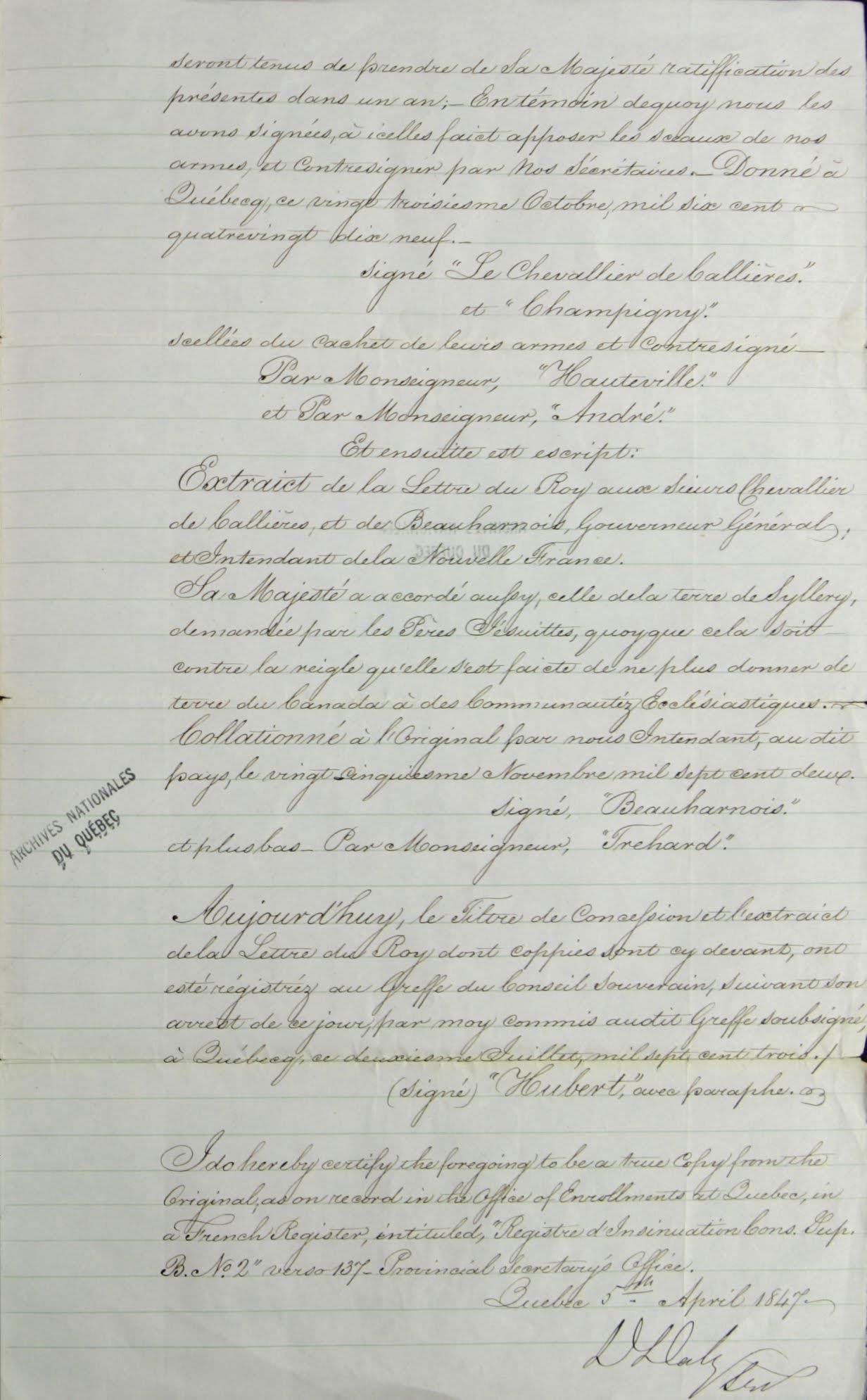
Pour ces raisons, nous avons donné, concédé, et octroyé en propre aux ditz Pères Jésuistes, les dits fief, terre et Seigneurie de Syllery d’une lieue de large, sur le fleuve Sainct Laurens, et d’une lieue et demie ou environ de profondeur jusques à la Seigneurie de Sainct Gabriel qui la termine par derrière, commençant du costé du Nord Est à la pointe de Puifseaux, et du costé du Sud Ouest à une ligne qui la sépare du fief des Gaudartville; lesquelles lignes ont esté tirées, l’une il y a environ vingt cinq ans, et l’autre il y a environ quarante; avecq tous les droictz et privilèges condédéz autrefois aux ditz Sauvages; pour tenir le tout en véritable fief, ne relevant que du Roy, avecq droit de haulte, moyenne & bafse justice, ainsy qu’ilspofsèdent toutes les autres terres que Sa Majesté leur a bien voullu accorder en ce pays; et pareillement, nous leur donnons, concédons et octroyons, en mesme titre de fief, et avecq les mesmes droitz et privilèges cy defsus spécifiéz, les dites quatre perches de terre de front sur huict de profondeur, concédées par few Monsieur de Montmagny, et les vingt toises en quarré d’augmentation concédées par few Mr Dailleboust, tous deux Gouverneurs Généraux de ce pays, au dit feu Pachirini, Capitaine Sauvage, pour du tout jouir par eux en propriété à toujours, en suivant la Coustume de Paris; à la charge que les apellations de la justice du dit Syllery resortiront devant le Sr. Lieutenant Général de la Prevosté de Québecq, et que les ditz Pères Jésuites seront enus de prendre de Sa Majesté ratiffication des présentes dans un an. En témoin dequoy nous les avons signées, à icelles faict apposer les sceaux de nos armes, et contrisigner par nos Sécrétaires. Donné à Québecq, ce vingt troisième Octobre, mil six cent quatrevingt dix neuf.

Signé « Le Chevallier de Callières. »
Et « Champigny. »
Scellées du cachet de leurs armes et contresigné
Par Monseigneur, « Hauteville »
Et Par Monseigneur, « André. ».

Et ensuitte est escript :

EXTRAIT de la Lettre du Roy aux Sieurs Chevallier de Callières, et de Beauharnois, Gouverneur Général et Intendant de la Nouvelle France.

Sa Majesté a accordé aufsy, celle de la terre de Syllery, demandée par les Pères Jésuites, quoyque cela soit contre la règle qu’elle s’est faicte de ne plus donne de terre du Canada à des Communautéz Ecclésiastiques.
Collationné à l’Original par nous Intendant, au dit pays, le vingt cinquiesme Novembre mil sept cent deux.
Signé, « Beauharnois. »
Et plus bas Par Monseigneur « Trehard. »

AUJOURD’HUY, le Titre de Concefsion et l’extraict de la Lettre du Roy dont conppies sont cy devant, ont esté régistréz au Greffe du Conseil Souverai, suivant son arrest de ce jour, par moy commis audit Greffe soubsigné à Québec, ce deuxiesme Juillet, mils sept cent trois.
(signé) « Hubert, » avec paraphe

I do hereby certify the foregoing to be a true copy from the original, as on record in the Office of Enrollments at Quebec, in a French Register, intitulated, “Registre d’Insinuation Cons. Sup. B. No.2” verso 137. Provincial Secretary Office.
Quebec 5th of April 1847
DDalz
Sec

Place d’Armes, in Trois-Rivières.

The Quebec Ministry of Culture and Communications, states that:

The heritage value of Place d’Armes lies in its historical interest. It reflects the rich past of the city of Trois-Rivières and its first urban development. The initial fief, conceded to the Algonquin Chief Charles Pachirini in 1648, is first of all an Indigenous encampment. It is however managed by the Jesuits who grant small lots to settlers from 1656 and thus becomes a French dwelling place.

In 1722, the land is converted into a public market. Became a place d’Armes in the second half of the 18th century, it was used for military exercises until the beginning of the 20th century. The Russian-made bronze cannon found there, dated 1828, was reported to have been brought back by soldiers from Trois-Rivières who participated in the Crimean War (1853-1856). The site still retains the name Place d’Armes although it is now used as an urban park.

The heritage value of Place d’Armes is also based on its interest in the history of Québec’s heritage conservation. Unlike the “Law on the Conservation of Monuments and Works of Art of Historical and Artistic Interest” adopted in 1922, the “Law for the Conservation of Historic and Artistic Monuments, Sites and Objects”, sanctioned in 1952 integrates landscapes and sites of scientific, artistic or historical interest in the properties likely to be protected. Place d’Armes, ranked in 1960, is the first protected place under this law.

However, buried in this 1699 contract below, we find that the land was transferred to the Jesuits, without any consultation with the Indigenous people who had occupied the land:

October 23, 1699
Concession
of the Seigneurie of Sillery
To the Reverend Jesuit Fathers

HECTOR de CALLIÈRE, Chevallier of the Order of Sainct Louis, Governor & Lieutenant General for the King in all northern France.

JEAN BOCHART, Chevallier Lord of Champigny, Noraie and other places, Councilor of the Kingdom in his Council, Intendant of Justice Police and Finances to the said country.

BY THE REQUEST presented to us by the Reverend Father Martin Bouvart, Superior of the Society of Jesus, in this country, and Father François Vaillant, his Prosecutor, who is eager to see us. Moreover, it pleases us to transfer to them the fiefs, land and lordship of Sillery, which they have enjoyed until present only as administrators of the property of the Christian Savages, to whom the said fief has tested given by His Majesty, in the month of July, 1651, and that the said Savages were obliged to give up ten or twelve years ago to settle elsewhere, both because the cultivated land was quite worn out, and that because firewood, cut for almost forty years, is far away from their homes, as in our faith, to transfer them as their own and in fiefs, eight perches (unit of measure) by four perches deep, conceded by Monsieur de Montmagny, and the addition of twenty squared fathoms conceded by the late Monsieur Dailleboust, both governors general of this country, to the late Pachiriny, Savage Chief in Three Rivers, whose so-called Jesuit fathers given for more than forty years, as tutors and administrators of the land of the said Pachiriny, contract with various private French individuals, to occupy them and to build on them, as they have done, for a small fee; aforementioned Pachiriny is now deceased, and the say Jesuit Fathers are to remain in the enjoyment of the said locations, which we are asked to give them the Concession; and are fully informed of the good intentions of the said Fathers of the Jesus, in recognition of the great spiritual and temporal help which they render to the Savages of this country, and of the grounds the care they took, and the extraordinary expenses they made to support the missions of the Savages, and to work solidly on their salvation, and especially on those who were established in the said place of Sillery, for which since they came out of it, done at their own expense on other lands in various places from this country, in order to establish them there; without which they would have dispersed.

For these reasons, we have given, conceded, and granted to the said Jesuit Fathers, the said fief, land and lordship of Sillery of a league wide, on the Saint Laurence river, and a league and a half or so deep down to the Seigneurie of Saint Gabriel, behind, starting from the northeastern coast at the tip of Ruisseaux, and from the south-west coast to a line that separates it from the fief of Gaudartville; which lines were drawn, one about twenty-five years ago, and the other about forty; with all the rights and privileges once condemned to the said Savages; to hold the whole thing in true fief, falling only to the King, with the right of justice, middle and good justice, as well as all the other lands which his Majesty has been good enough to grant them in this country; and likewise, we give them, concede and grant, in the same title of fief, and with the same right and privileges specified, the so-called four perches of land abreast on the depths of the body of water, conceded by the defunct Monsieur de Montmagny, and the twenty fathoms in square footage conceded by Mr. Dailleboust, both governors general of this country, to the said late Pachirini, Sauvage Chief, to enjoy by all in their property forever, following the Coutume de Paris; to the charge that the appellations of the justice of said Syllery will spring before the Sr. Lieutenant General of the Prevost of Quebecq, and that the said Jesuit Fathers will be able to take of his Majesty ratification present in one year. In witness of which we have signed them, they have to affix the seals of our arms, and to compel by our Secretaries. Given at Quebecq, this twenty third of October, one thousand six hundred and ninety-nine.

Signed “Le Chevallier de Callières. ”
And “Champigny. ”
Sealed with the seal of their arms and countersigned
By Monseigneur, “Hauteville”
And By Monseigneur, “Andre. “.

And below:

EXTRACT from the Letter of the King to Sieurs Chevallier de Callières, and Beauharnois, Governor General and Intendant of New France.

His Majesty has granted also, that of the land of Sillery, demanded by the Jesuit Fathers, that it is against the rule that it has made itself no longer to give land of Canada to Ecclesiastical Communities.

Collated with the Original by us Intendant, in the said country, the twenty fifth of November, one thousand seven hundred and two.
Signed, “Beauharnois. ”

And below By Bishop Trehard. ”

TODAY, the Title of Concession and the extract from the Letter of the King, of which it is in the foreground, have been registered with the Registry of the Sovereign Council, following his arrest of that day, by means of the said registry at Quebec, this second July, mils seven hundred and three.
(signed) “Hubert,” with initials.

(The following was entered in English)

I do hereby certify the foregoing to be a true copy from the original, as on record in the Office of Enrollments at Quebec, in a French Register, intitled, “Registre d’Insinuation Cons. Sup. B. No.2” verso 137. Provincial Secretary Office.
Quebec 5th of April 1847
DDalz
Sec
Le calcul du coût d’une reconnaissance de l’identité métisse: trop cher, mais nécessaire?

Je me suis réveillé en pensant aux économies d’échelle et à l’identité autochtone.

Je pense que le nombre de Métis est gonflé pour une raison financière.

Voici pourquoi:

Afin qu’une communauté métisse soit reconnue, ses membres doivent avoir recours aux tribunaux.

C’est généralement pour faire face à des accusations relatives aux droits de récolte ou de l’occupation territoriale des terres de la Couronne.

En passant, les terres de la Couronne devraient automatiquement être restituées aux Premières Nations et aux Inuit.

En général, cela commence quand une personne est arrêtée pour «chasse illégale» ou parce que des «cabanes de chasse» étaient réputées être illégalement sur les terres de la Couronne.

C’est ainsi que débute un long parcours le système judiciaire – qui sera garanti se rendre jusqu’à la Cour suprême du Canada.

Chaque niveau doit être financé par des centaines de milliers de dollars. Le ou les défendeurs doivent engager des avocats et des témoins experts et assumer tous les coûts associés.

Les témoins experts doivent fournir des preuves empiriques de l’existence historique d’une communauté – avant la vague notion coloniale de «contrôle effectif», qui est une date non définie et différente partout.

Chaque membre de la communauté doit fournir au moins une lignée ancestrale validée reliant un ancêtre «indien», avec les enregistrements de naissance et de mariage.
Les documents civils sont difficiles à obtenir (voir ma publication concernant les registres de baptêmes non-indexés de ma communauté) et obtenir une généalogie complète avec ses documents coûte plus de 250 $ chacun.
À ce propos, même les Métis de la rivière Rouge doivent avoir *une* seule ligne ancestrale vérifiée. La famille Powley aussi.

Ensuite, une communauté doit démontrer des preuves de son existence jusqu’au moment de «l’infraction».

La défense poursuivra ses efforts pour prouver que la communauté était réellement “absorbée” par le pouvoir en place, c’est-à-dire par la gouvernance anglaise ou française du temps.

Les tribunaux veulent que cela soit prouvé comme s’il existait une sorte de «club» doté de rôles d’adhésion, de procès-verbaux et d’assemblées générales annuelles.

Tout cela coûte beaucoup d’argent. Au moment où une affaire est jugée auprès de tout le système judiciaire, nous estimons que la facture totale se situe à près d’un million de dollars, voire plus.

Il y a beaucoup de tactiques de blocage. Parce que le temps égale plus de frais d’avocats.

À moins qu’une société avec un intérêt acquis ou une sorte de bienfaiteur soit prêt à payer la facture, les membres d’une communauté doivent supporter les coûts.

Bien entendu, les tribunaux prennent rarement en charge ces coûts.

C’est tellement pernicieux et cela ouvre la porte à ce que les communautés s’entraînent avec des sociétés d’extraction de ressources qui offrent des services de consultation:

Cette liste publiée par le gouvernement de l’Alberta est une compilation de consultants en recherche autochtones reconnus. Vous remarquerez les grands acteurs habituels tels que Stantec et SNC Lavalin:

https://open.alberta.ca/publications/list-of-alberta-historic-resource-consultants

Ainsi, dans des endroits comme le Chicot, sans ressources commercialisables connues, la quête de la reconnaissance de notre communauté, avec seulement environ 300 ménages qui s’identifient comme Métis, nous devrions en supporter les coûts nous-mêmes.

Donc:

$1 000 000 ÷ 300 = $3 333 par ménage

3 333 $ par ménage pour prouver l’existence d’une communauté métisse.

C’est un coût trop difficile à supporter pour une région économique où le revenu moyen des ménages est inférieur à 50 000 dollars par an.

Ainsi, la seule option serait de créer une sorte de société ou de club, d’ouvrir un registre et de choisir des abonnements à 50 dollars la carte pour générer un revenu permettant de couvrir les coûts.

$1 000 000 ÷ $50 = 20 000 membres.

Environ 1 200 personnes s’identifient comme Métis au Chicot.

En tant que planificateur financier, ces chiffres n’ont aucun sens.

Un million de dollars n’est même pas un investissement, car il n’y a aucune récompense autre que la reconnaissance à la fin de décennies de procédures judiciaires.

Cela amènera seulement le gouvernement à “reconnaître” l’existence du Chicot.

Alors, entre-temps, moi-même et les autres Métis Chicot continuerons de nous appeler des faux, des fétis, des appropriateurs culturels.

Et le gouvernement colonial se réjouit.

Can you spare $1,000,000? The Economics of proving Identity

I woke up thinking about economies of scale and Indigenous Identity.

I think numbers of Métis is inflated for a financial reason.

Hear me out:

To have a Métis community recognized, its members must use the Courts.

Usually, it’s over Harvesting rights or territorial occupation of Crown lands.

p.s.: Crown lands should automatically be returned to First Nations and Inuit.

Usually, it’s initiated when someone is arrested for an “illegal hunt” or because their “hunting cabins” were being deemed to be illegally on Crown land.

Hence, begins a long and drawn-out path thorough the Court system – which will be garanteed to be fought right up to the Supreme Court of Canada.

Each level of Court take hundreds of thousands of dollars to see through. The defendant(s) must hire lawyers, expert witnesses and cover all costs associated.

The expert witnesses need to provide empirical evidences of a community’s historical existence – prior to a vague Colonial concept of “effective control” which is a non-defined date different everywhere.

Each member of the community must provide a minimum of one vetted ancestral line linking to an “Indian” ancestor, complete with birth and mariage records.

Records are difficult to obtain (see my posts regarding the un-indexed records of my community) and cost upwards of 250$ each.

By the way, even Red river Métis need to have *just one* ancestral line verified. So did the Powley family.

Then, a community needs to show evidences that it continued to exist right up to the time of the “infraction”.

The Crown’s defense will attempt to prove that the community was actually *absorbed* into the ruling power, i.e. either English or French rule.

The way the Courts want it proven is as if some kind of “club” existed with membership roles, minutes and Annual General meetings.

All this costs LOTS of money. By the time a case makes its way through the court system, we’re looking at close to, and even over a million dollars.

There’s lots of stalling tactics. Because time equals more money.

Unless some corporation with a vested interest or some sort of benefactor is ready to foot the bill, members of a community must bear the costs.

Of course, the Courts seldom provide for these costs.

It’s so pernicious, and opens the door to communities becoming embroiled with resource-extraction corporations who offer “consulting”:

This list published by the government of Alberta is a compilation of recognized Indigenous research consultants – you’ll notice the usual big players such as Stantec and SNC Lavalin in there:

https://open.alberta.ca/publications/list-of-alberta-historic-resource-consultants

So, in places such as the Chicot, with no known marketable resources, the quest to have our community recognized, with only approximately 300 households who identify as Métis, we’d have to bear the costs ourselves.

$1,000,000 ÷ 300 = $3,333 per household

$3,333 per household to prove the existence of a Métis community.

That’s too much to bear for an economic region where the average household income is less than $50,000 per year.

So, the only option would be to form some sort of corporation or club, open up a Registry, and shill memberships at $50 bucks a card to provide income to cover the costs.

$1,000,000 ÷ $50 = 20,000 members.

There are only about 1,200 people who identify as Métis at the Chicot.

I’m a Financial Planner and those numbers just don’t make any sense.

$1,000,000 isn’t even an investment because there are no rewards ither than recognition at the end of decades of Court processes.

It will only lead to the government “recognizing” that the Chicot exists.

So, meanwhile, myself and other Chicot Métis will continue being referred to as fakes, fétis, cultural appropriators.

And the Colonial government rejoices.

Métis Nation Colonizers

So we spent multiple generations and gathered from everywhere all the names we were known to call ourselves and how other people referred to us.

We then looked for all the research to prove that all these names meant we were not First Nations but were tied by kinship with the Original People.

We chose one name – Métis – that represented us all and had that name recognized by the government and included in the Constitutional Act.

Then, one group, representing a small portion within a delimited geographic area, took all the government money. They use it to campaign against people who shared everything: the names we call ourselves, the research to prove those names and the success in the recognition of the name.

That group trademarked the name Métis and also kept all the other names we called ourselves.

They tell you it’s about White people appropriating Indigenous identity.

This slideshow requires JavaScript.

It’s not.

This group, and EVERY SINGLE OF ITS MEMBERS are now Colonizers. Anyone who participates, promotes, supports their actions are COLONIZERS.